
Ductless
A new ductless system for the shop that stopped keeping up
Plenty of farm properties around Hickory Grove have a ductless unit on a shop, a barn office, or a building that started as storage and turned into somewhere people work. Some of those systems have simply worn out. Others were too small from day one and spend every July running flat out without catching up. Replacing one is a chance to size it to the building as it gets used today.
We are Zach and Eric Massey, the family behind EZ Heating and Cooling, a company we opened in 2023 on top of more than 25 years in the trade. Call any hour of the day or night; an emergency visit carries no added fee.

Signs the ductless unit on the outbuilding is finished
Outside: the coil and the flare joints
The outdoor unit takes the weather full time. On an older system the coil fins corrode and crumble, especially where the unit sits low beside a gravel drive or a field that gets worked every season. Refrigerant leaks show up at the flare joints where the line set meets the unit, often as an oily stain around the nut, and a system that needs topping off every year is losing charge somewhere.
A single flare leak on a sound system is a repair, and we treat it as one. A coil corroded through in several places, on an aging unit that has already had its share of patches, belongs on the replacement side of the sheet.
Inside: the board and the head
Storms knock the power out on the western roads, and every blip and restart puts a jolt through a mini split’s electronics. A control board that throws fault codes after each outage, or a head that blinks and quits on hot afternoons, has often taken more surge damage than one part swap can cure.
The other sign is simpler. If the head runs nonstop in July and the shop still sits warm and sticky by midafternoon, the system may never have been big enough, or the building around it has changed. A new unit of the same size would do the same thing, so we figure out why before quoting anything.
Sizing the replacement to how the building works now
Insulation gets looked at first
A metal building with no liner, a barn with gaps along the eaves, or a block shop with an uninsulated roll-up door can swallow whatever capacity you throw at it. Before sizing a new system, we look at the walls, ceiling, doors, and windows, because sealing and insulating one weak spot often lets a smaller, steadier unit carry the building.
The photo further down shows a head hung on strut channel in a metal building with a white insulated liner. A liner like that makes a ductless system’s job far easier. Bare metal with no liner can run hot enough on a July afternoon to beat almost any head we could hang on it.
What the room does all day
A barn office where one person does paperwork needs less than a shop where a welder runs and the big door opens every hour. Equipment throws heat, people come and go, and a building used for winter repairs needs real heating capacity along with summer cooling. We ask how the space works week to week and size the replacement from those answers plus a load calculation.
Sometimes the answer is two smaller heads instead of one big one, so the far end of a long building gets air too. Sometimes it is the same size as before, and the building was the problem all along. We put the reasoning on paper either way.
Placing a new head where shop dust and equipment live
A ductless head pulls room air through a fine mesh filter and across its coil, so in a building full of sawdust, feed dust, or grinding grit it clogs quickly. We place the new head away from the bench and the saw where we can, high enough to throw air across the room, and somewhere you can reach the filters without moving a tractor. Then we show you how to pull and rinse them, because in a working building that chore comes around often.
Outside, the condenser goes up on brackets or a stand, clear of drifting debris and splash off the drive, with room left to service it. Electrical runs to code with a proper disconnect within reach of the unit, and we recommend a surge protector on every outbuilding install, since storm cells out here are hard on electronics. Our mini split replacement overview lays out how every ductless changeout runs.
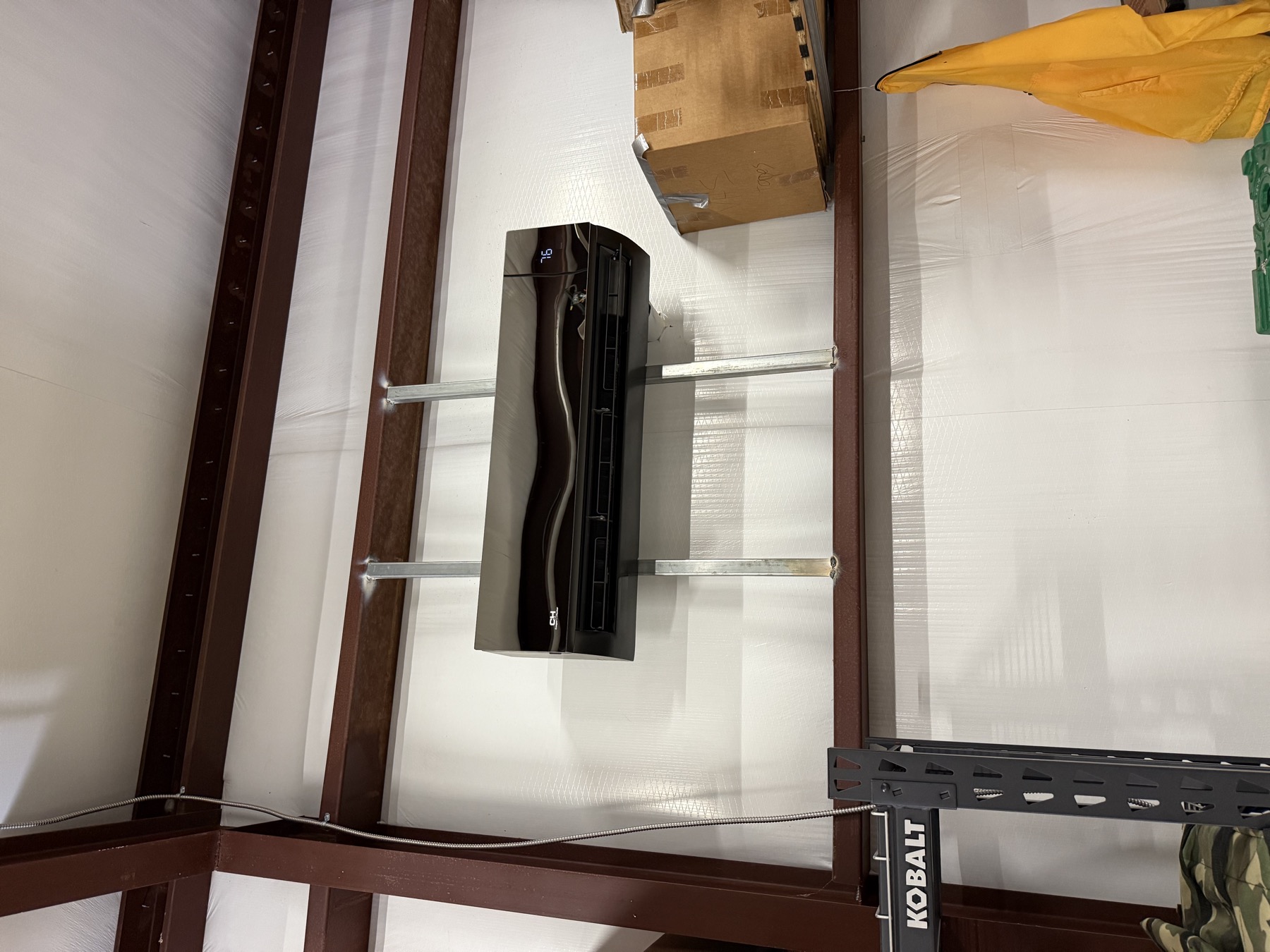
Hung on strut channel against an insulated liner: in a metal building, the mounting and the insulation decide whether a new head keeps up.
Keep the old line set, or run new copper?
When the existing lines can stay
Reusing a line set saves time and wall patching, and sometimes it is the right call. If the copper is the size the new unit calls for, holds a nitrogen pressure test, and the run is a length the manufacturer allows, we flush it clean, make fresh flares, and pull a deep vacuum before charging.
We write down what the test showed, so you can see the old lines earned their keep. A line set buried inside a finished wall, or run through a ceiling somebody just paneled, is worth saving when it passes, and we try every honest option before asking anyone to open that wall back up.
When they come out
Copper that is the wrong size, kinked, crushed behind equipment, or chewed by something living in the barn comes out. So does a line set that leaked at the flares more than once, or one whose insulation has gone soggy and black from years outdoors. Wet insulation sweats and drips, and in a shop that drip lands on whatever is parked under it.
New lines go in with outdoor-rated insulation, covered where the sun beats on them, and routed clear of doors, ladders, and a forklift’s path. Where the old wall penetration leaked air or water, we seal it while we are there.
What changes once the new ductless unit is running
Heat for winter work
Heat-pump mini splits heat as well as they cool, so a replaced system can carry a shop through cold mornings without a kerosene heater smoking in the corner. If you only ran the old unit for cooling, ask about heating with the new one. For many outbuildings it changes what work can happen in January.
A wall controller or an app lets you set the building back when nobody is there and bring it up before the crew arrives, which is easier on the equipment than big swings all day.
Humidity is the quieter win. A properly sized head runs long enough to pull moisture out of a closed building in summer, which keeps rust off hand tools and mildew off whatever is stored in the barn office. An oversized unit chills the air fast and shuts off before it dries anything.
The rest of the property
Once one outbuilding is comfortable, people start eyeing the next, and we are glad to plan those in whatever order suits the farm. If the main house furnace is getting up in years, our furnace replacement page for Hickory Grove covers the farmhouse side.
Dusty buildings send dust back into the house on boots and clothes. If allergies run in the family, the air purification page walks through filtration that helps the house stay cleaner.
Not sure the old unit is worth saving?
We test the outdoor coil, the joints, the board, and the line set, then hand you a written repair price beside a written replacement price for the building.
Questions shop and barn owners ask about ductless replacement
How do I know if my mini split needs replacing or just a repair?
We test before saying anything: refrigerant pressures, the flare joints, the outdoor coil, the control board, and the fan motors. One leaking joint or a failed sensor on a healthy unit gets repaired. A coil corroded through in several spots, or a board that keeps failing after outages on an older system, usually points to replacement.
My ductless unit runs all day in summer and the shop is still hot. Why?
Usually the unit was too small for the building, or the building changed, with more equipment, more people, or a door that stays open. Poor insulation is a common cause too. We check the building first and size the new unit to how you use it now, so the same problem does not come back.
Can you reuse my existing line set?
Sometimes. If the copper is the correct size, passes a nitrogen pressure test, and fits the new unit’s length limits, we flush it, make new flares, and reuse it. Kinked, damaged, or undersized lines, or lines with soaked insulation, get replaced, and we explain which case you have.
Where should the new indoor head go in a dusty shop?
Away from the main source of dust where possible, high on a wall so it can throw air across the room, and somewhere you can reach the filters easily. In a dusty building those filters need regular rinsing, and we show you how before we leave.
Do power outages damage mini splits?
They can. The surge when power comes back after a storm is hard on control boards. A surge protector at the outdoor unit helps a great deal, and we recommend one on every outbuilding install. If your board keeps faulting after outages, we test it to find out what was damaged.
Will a new mini split heat my shop in winter too?
Heat-pump mini splits heat as well as cool, and they carry most outbuildings through a Carolina winter. If heat matters for winter work in the building, tell us up front so we size and choose the unit with heating in mind.
Is there financing or a discount on a new ductless system?
Yes. You can finance the replacement through Optimus, and teachers and service personnel receive a ten percent discount. Let us know when we price the building and it will be written into the quote.
The rest of what we do around Hickory Grove
Our Hickory Grove page is where the whole farm-country picture lives, house and outbuildings together. Inside the main house, an aging closet unit has its own page for furnace replacement. Dry winter rooms are handled through humidifier installation, a whole-house unit that stopped working goes to humidifier repair, and the dust that rides in from the fields belongs to air purification systems.
Want to see ductless work we have finished? Our gallery shows real installs, photographed on the job by our own crew.