
Ductless · The overview, in plain English
Ductless mini splits, explained honestly by the people who install them every single week
A mini split is a heat pump with no ductwork: a compact outdoor unit, one or more sleek indoor heads, and a refrigerant line connecting them through a three-inch wall opening. It heats in winter, cools in summer, sips electricity doing both, and it conquers the exact rooms central air gave up on years ago, usually in a single install day.
This page is the honest overview: what ductless does brilliantly, where it makes less sense, and what a real installation involves. When you are ready to go deeper, the installation, replacement, and repair pages each have their own detail, and the phone works for everything in between.
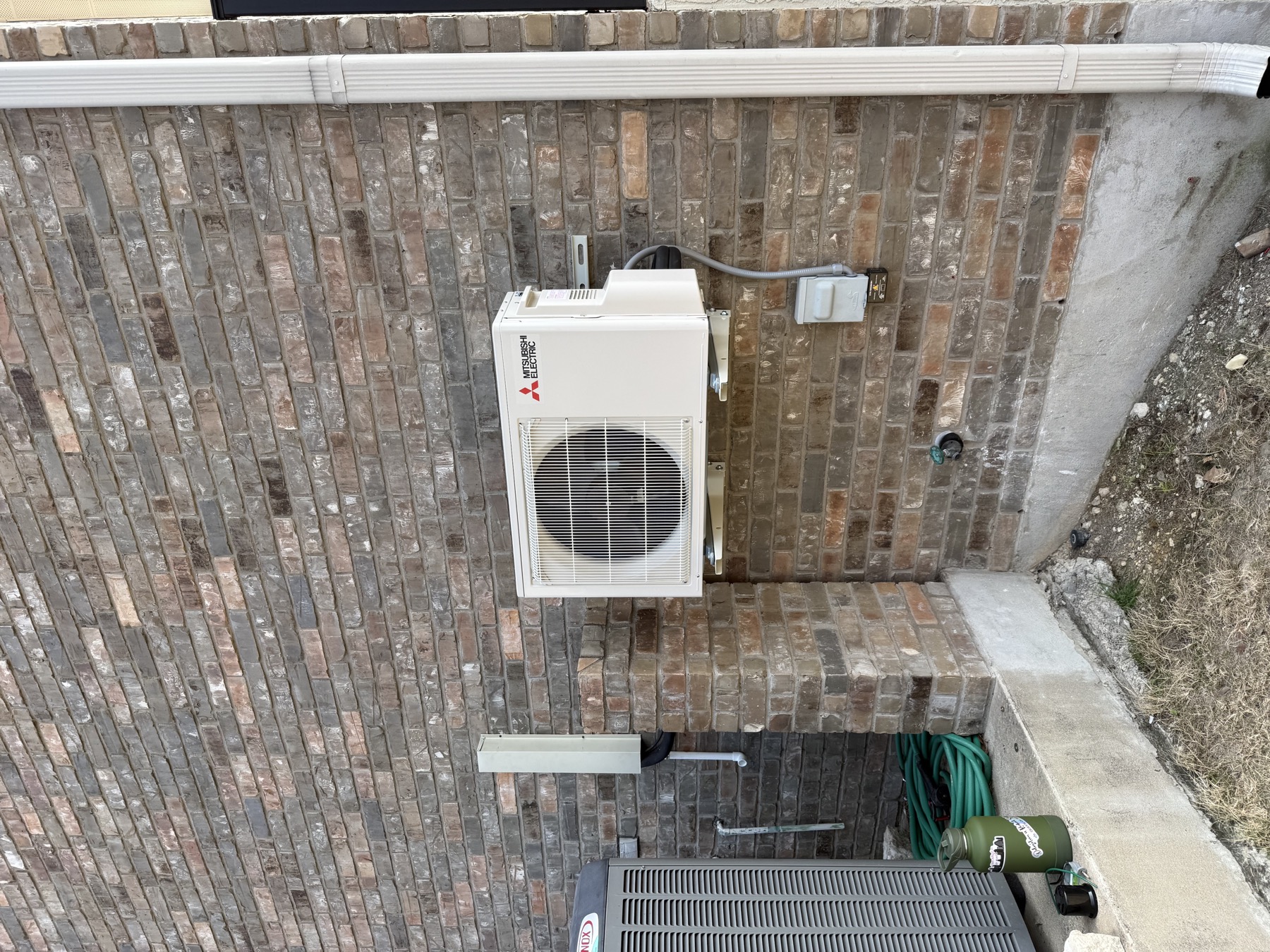
Where ductless wins outright
The rooms ducts never reached
Every house in the Carolinas seems to have one: the bonus room over the garage that bakes all summer, the sunroom that is unusable four months a year, the garage workshop, the finished basement corner, the addition the original system was never sized to carry. Running new ductwork to those spaces is invasive and often physically impossible. A mini split solves the whole problem on one wall, in one day, with its own thermostat.
We install a lot of them in exactly those places: heads in vaulted bonus rooms the central system could never pressurize, black cassettes in metal workshops, quiet units over new-construction windows before the drywall went in. The gallery has several, all real, all local, and every one of them ended a years-long comfort argument in an afternoon.
Zoning, efficiency, and quiet
Because each head runs independently, ductless is zoning without the complexity: cool the bedroom at night without paying to cool the empty living room, heat the office all day without heating the whole house. Duct losses, which quietly eat a chunk of many central systems’ output in attics and crawlspaces, simply do not exist, because there are no ducts to leak.
Modern inverter-driven mini splits also modulate rather than blasting on and off, which makes them astonishingly quiet and efficient at holding a setpoint. The indoor heads whisper. The outdoor units hum politely. People who grew up with window units or aging central systems routinely refuse to believe the thing is running until they hold a hand to it.
Where ductless is the wrong tool, honestly
The cases we talk people out of
Whole-house ductless in a home with healthy existing ductwork rarely pencils: a central system replacement usually costs less than four or five heads and serves the same square footage. Houses with deep interior rooms and no good head placements can end up with coverage gaps. And if the aesthetic of a wall-mounted unit genuinely bothers you in a formal living room, that matters, because you will look at it daily for fifteen years.
There are workarounds, ceiling cassettes and slim ducted heads among them, and we quote them when they genuinely fit the room. But the honest starting point is that ductless is a precision tool, spectacular in the right applications and forceable into the wrong ones only with money and regret. We will tell you which case your house is at the free pricing visit, in writing, and our reviews across Google, Yelp, and Nextdoor suggest we tell it straight even when it costs us the bigger sale.
Ductless versus extending central air
For additions and conversions, the real comparison is a mini split against extending your existing system. Extension sounds tidy until the math arrives: the existing system was sized for the old house, the new duct runs are long and lossy, and the extension often degrades comfort everywhere to deliver mediocrity in the new space. A dedicated ductless zone usually wins on cost, comfort, and the health of the original system.
The exception is new construction planned from scratch, where designed-in ductwork competes well. That is a real design conversation with real trade-offs, and it is exactly the kind we like having at kitchen tables with both options priced in writing. Twenty minutes of honest comparison beats fifteen years of the wrong guess.
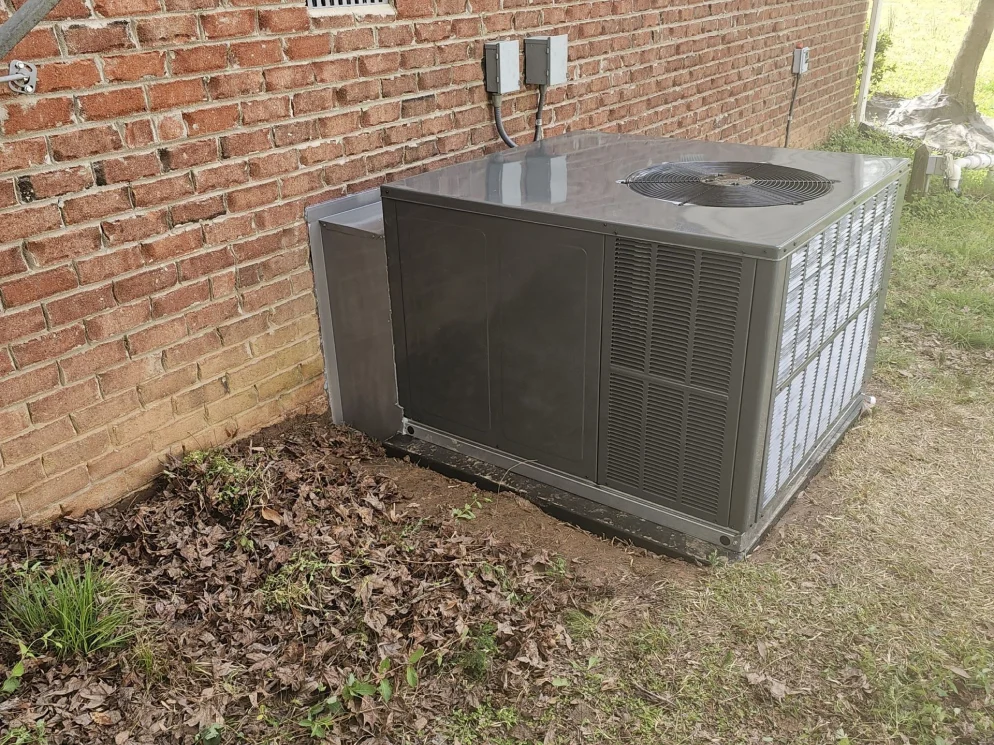
A package unit set at an older brick home.
What a ductless project actually involves
The anatomy of an install
A single-zone setup is refreshingly contained: mount the indoor head, hang or pad-mount the outdoor unit, connect them with a refrigerant line set and control wiring through a small penetration, handle the condensate drain, and commission the system with instruments. Done carefully, it is a one-day job that leaves almost no trace beyond the equipment itself.
Multi-zone systems, one outdoor unit feeding several heads, add design complexity that rewards experience: line lengths, head sizing per room, and the outdoor unit’s capacity all interact, and a badly designed multi-zone is how ductless gets an undeserved bad name. Ours get designed on paper first, installed cleanly second, and the line sets routed like we expect the photos to end up in our gallery, because they do.
Brands, sizing, and the details that age well
Mitsubishi earns most of our ductless installs on reliability and cold-weather performance, with other major brands quoted where they fit the budget honestly. Sizing matters as much as it does in central systems: an oversized head short cycles and dehumidifies poorly, an undersized one runs flat out and loses August. We size from the room’s actual load, insulation, and sun exposure, never from a catalog shortcut.
The aging-well details are the ones nobody sees at handshake time: line sets sleeved and sealed against Carolina weather, condensate routed to drain properly rather than onto a walkway, outdoor units mounted clear of roof runoff and mud splash, and penetrations sealed like the wall was never opened. Every one of those is the difference between a system at year ten and a service call at year three.
Living with mini splits in the Carolinas
Four seasons on one wall
Modern mini splits are heat pumps at heart, and this climate flatters them: efficient cooling through our long muggy summers, efficient heating through winters that mostly sit in the 30s and 40s, and cold-weather models that keep producing heat well below freezing for the snaps. For garages, workshops, and bonus rooms, one head genuinely covers the whole calendar.
Humidity control deserves a mention too. Inverter heads running long gentle cycles pull moisture steadily, and many models offer a dedicated dry mode for the soupiest weeks. A bonus room that used to be both hot and sticky usually comes out of an install feeling like the best-conditioned space in the house, which causes a specific kind of family dispute we cannot help with.
Care and feeding, the short version
Ductless maintenance is homeowner-friendly: the head’s washable filters rinse clean in a sink monthly during heavy seasons, and that one habit prevents most problems. The professional visit once or twice a year handles the rest: deep coil cleaning, drainage check, refrigerant verification, and the outdoor unit’s health. Neglect shows up as weakened airflow, musty smells, or water where it should not be, and the repair page covers what to do when it does.
Remote batteries and a gentle vacuum of the head’s intake are the entire remaining curriculum, and we demonstrate all of it before leaving the install. As machines go, a well-installed mini split asks very little and gives a great deal, which is roughly the energy we aim for in all our long-term relationships, mechanical and otherwise.
Ductless pricing, in the open
Single-zone installs are the most affordable way to condition a space that has never had it, and multi-zone quotes come designed on paper with each head sized and priced in the written total. The pricing visit is free anywhere in the 30-mile radius, qualifying projects can run through Optimus Financing, and teachers and service personnel take 10% off like they do on everything else we sell.
The quote conversation includes the honest comparison against your alternatives, extension, window units, or doing nothing another year, with real numbers attached to each. Ductless sells itself in the right room, and we would rather let it than push it. The gallery holds several finished installs from around the metro if you want to see the standard before anyone visits.
Stuck between repair and replace?
Call and describe what the system is doing. We run the math at your kitchen table, in writing, and the decision stays yours.
Ductless questions, answered plainly
Do mini splits really heat well in winter?
In this climate, yes, comfortably. Carolina winters live mostly in the 30s and 40s, squarely inside modern mini splits’ efficient range, and cold-climate models hold useful output well below freezing. For a garage, bonus room, or addition, a properly sized head carries the whole winter here, snaps included, and the power bill stays polite while it does.
How many rooms can one outdoor unit serve?
Multi-zone outdoor units commonly feed two to five indoor heads, with the practical limit set by capacity math rather than the port count on the cabinet. Every added head interacts with line lengths and the unit’s total output, which is why multi-zone design happens on paper before anything gets drilled through anything. Done right it is elegant and efficient. Done by port-counting it is a callback wearing a warranty claim.
Are they ugly? Be honest.
The standard wall head is a clean white rectangle that most people stop noticing within a week, and placement makes most of the difference. Where the look genuinely will not do, ceiling cassettes and slim concealed-duct heads hide the equipment almost entirely for more money. We will show you the options against your actual room and let your eyes vote.
What does a mini split cost to run?
Less than nearly anything else delivering the same comfort. Inverter efficiency, zero duct losses, and zone-only conditioning stack up: cooling one bonus room costs a fraction of running the whole central system to achieve the same result. Owners heating workshops on resistance heaters see the sharpest drop, and it shows up on the very next bill.
Can I install one myself? The internet says I can.
The internet undersells the failure modes. DIY kits exist, but refrigerant handling, line evacuation, and commissioning are exactly the steps that decide whether the system lasts fifteen years or limps through three, and a botched vacuum quietly voids most warranties. The visible parts are easy. The parts that matter are not, and they are why the professional install costs what it does.
How long does an installation take?
A single-zone install typically finishes in one day, often by early afternoon, including commissioning and cleanup. Multi-zone projects run one to two days depending on head count and routing. New-construction installs get sequenced with your builder so the heads go in before drywall, which produces the cleanest result of all.
Can a mini split dehumidify a musty room?
Meaningfully, yes. Long gentle inverter cycles pull moisture steadily, and dry mode prioritizes humidity over temperature for the soupy weeks. For genuinely damp spaces, basements and crawl-adjacent rooms, the honest answer sometimes pairs a head with dedicated dehumidification, and we will tell you which case yours is rather than overselling either machine.
Which spaces do you install them in most around here?
Bonus rooms over garages lead by a mile, with garages, workshops, sunrooms, additions, and finished basements close behind. We have also cured plenty of upstairs master bedrooms that never matched the thermostat, and a few she-sheds and studios that are now the most comfortable square footage on the property. If a space has walls and a comfort problem, it is probably on our list.
Going deeper on ductless
This overview has three detail pages underneath it, plus the neighbors that ductless decisions usually touch.
Mini-Split Installation · Mini-Split Replacement · Mini-Split Repair · Heat Pump Services · AC Installation
Want proof before the phone call? The gallery is all real jobs, and the financing page covers the big-ticket math.