
Lancaster County · The panhandle’s rural holdout, minutes from the boom
Van Wyck HVAC for the countryside the corridor has not caught yet
Van Wyck is what the panhandle looked like before the boom: a small community of acreage properties, long driveways, older farmhouses and newer homes on real land, sitting improbably close to one of the fastest-growing corridors in the Carolinas. Indian Land’s rooftops march visibly closer every year, the town incorporated partly to steer its own future, and the residents who chose land over lots would mostly like to keep the difference. The mechanical service for a place like this has to respect what it is, not treat it as a subdivision that has not happened yet.
We serve Van Wyck from Fort Mill, fifteen minutes up the road, with the rural edition of the roster: systems on acreage properties that work harder across bigger volumes and longer runs, crawlspaces and outbuildings with their own agendas, well-house and shop conditioning that subdivision crews never learn, and honest arrival windows for addresses that GPS occasionally debates. Flat prices, no mileage games, and the 24/7 line covering every long driveway in the community without a surcharge.
The holdout, mapped
Where we work
From the community’s center out along the roads that thread the panhandle’s remaining countryside, Van Wyck sits minutes from our Fort Mill shop and a world away from the corridor next door. The properties run bigger, the driveways run longer, and the service respects both: honest windows, trucks stocked for rural realities, and prices that read identically to the subdivision fifteen minutes north.
The county page carries the full panhandle story, with Indian Land holding the boom next door and Lancaster the county seat down the road. This page belongs to the countryside in between.
The short version
Acreage properties served by a crew that understands acreage: bigger volumes, longer runs, crawlspaces and outbuildings with their own agendas, and honest windows for addresses the GPS debates. The countryside deserves service built for it, not subdivision service that got lost.
Acreage mechanics, honestly practiced
Bigger houses, longer runs, real loads
Acreage homes work their systems differently than subdivision stock: bigger volumes to condition, duct runs stretched across real square footage, exposure on all four sides with no neighboring walls sharing the load, and additions accumulated across ownership generations. Right-sizing matters more out here, not less, and the load calculations get done on the actual house rather than a builder’s spreadsheet from a different decade.
The balancing craft earns its keep across the long floor plans, far bedrooms disagreeing with distant thermostats for reasons only measurement can name, and the corrections price cheapest-first as everywhere: dampers and returns before anyone discusses equipment. Rural systems that get the measured treatment deliver comfort the subdivision versions rarely match, because the houses were worth conditioning properly in the first place.
Crawlspaces, wells, and the country agenda
Country crawlspaces run generous and honest: real height, real moisture after rains, duct insulation failing from below, and the occasional resident wildlife the subdivision crews never meet. The readings-first sequence applies at acreage scale, sources found, drainage and sealing where the ground demands it, duct restoration up off the damp, and dehumidification where the numbers justify the machine.
Well houses need freeze protection that actually works, pump sheds have their own conditioning logic, and the whole water-infrastructure layer adds calls the corridor never generates. We treat it as core competence rather than exotic territory, which is precisely the difference between rural service and subdivision service that got lost on a long driveway.
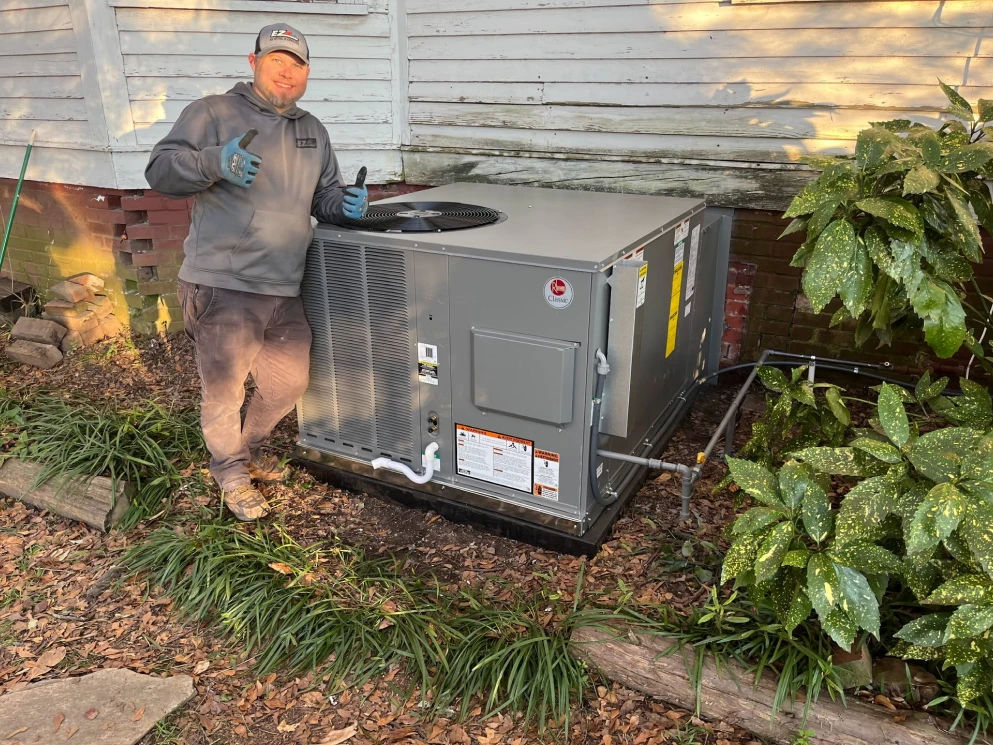
A newly set package unit and the tech who set it.
Shops, barns, and the outbuilding economy
The buildings behind the house
Acreage life accumulates buildings: workshops that grew from sheds, barns holding equipment worth protecting, garages that became second workshops, and the project spaces country properties generate naturally. Each one is mini-split territory, sized to its real exposure and use: insulation checked honestly first, placement respecting dust and equipment, electrical run to code with proper disconnects.
The workshop conversation usually starts with one building and spreads, because a conditioned shop changes what a property can do year-round: summer projects that no longer end at ten in the morning, winter work that no longer requires a kerosene heater and a tolerance for fumes, and stored equipment that stops sweating through the humid months. The outbuilding calendar keeps our Van Wyck visits interesting, and we like it that way.
Veteran systems and the long-ownership pattern
Country properties change hands slowly, and their mechanical histories run long: systems installed decades back, maintained personally, repaired sensibly, and now facing the keep-or-retire question with owners who know every duct joint personally. The standing honesty applies: instruments before verdicts, repairs priced beside replacements in writing, and genuine extra seasons earned wherever the readings support them.
The strips-and-propane economics get run honestly too: heat pumps carrying the mild season beat resistance strips everywhere, and they increasingly beat propane’s delivered-fuel pricing across the shoulder months, with dual-fuel setups keeping the backup for the coldest snaps. The arithmetic gets shown at the kitchen table, property by property, and the answer follows the numbers rather than a sales quota.
The boom next door
Living beside the corridor
The 521 corridor’s growth is visible from Van Wyck’s edges, and its effects arrive even where its rooftops have not: traffic reshaping the roads, land values climbing, and the occasional new build appearing on subdivided acreage running the metro’s builder-grade script in miniature. The pattern file stands ready for those addresses, year-two checkups, staging configuration, filtration upgrades, while the countryside around them keeps its own agenda.
The community’s incorporation gives it a say in its own future, and whatever that future holds, the mechanical service model stays the same: each property served on its actual terms, acreage or lot, farmhouse or new build, with the same instruments and the same written prices across every one of them.
Fifteen minutes from the shop
Van Wyck’s proximity is the quiet advantage of the whole arrangement: close enough to Fort Mill for genuinely fast response, rural enough that most trades treat it as an afterthought. Emergency calls run the honest short quote, routine work slots flexibly into the southern route, and the maintenance rhythm’s twice-yearly visits arrive without the scheduling friction distance usually adds.
The 24/7 line covers every long driveway at the standard no-surcharge price, night calls included, vulnerable households first as everywhere. Country properties with country infrastructure deserve emergency service that actually shows up, and the fifteen-minute geography makes Van Wyck one of the easiest promises on our whole map to keep.
A countryside year, in service calls
The warm half
Spring opens with pollen off the fields and trees loading every outdoor coil in the community, and the maintenance batches book the acreage circuit early; summer runs the cooling campaign across the big volumes, long-run systems working their full loads, crawlspace moisture at its most instructive, drain pans earning their float switches, and the storm cells taking their electrical toll on well pumps and condensers alike. Surge protection earns its line in every rural quote.
The workshop projects sketched over winter become installs by June, and the maintained properties demonstrate their spring service in the margins while the skipped-service systems explain themselves one capacitor at a time.
The cold half
First snaps examine the countryside at dawn: veteran furnaces explaining skipped fall service, well houses testing their freeze protection, propane tanks meeting their winter pricing, and the 24/7 line working its short-drive shift at honest windows. Fall-serviced systems show their preparation, and the dual-fuel conversations work the kitchen tables through the season.
Shoulder seasons belong to the planners: replacements booked calmly, outbuilding projects sequenced, conversions closing their math, and the maintenance rhythm signing its acreage growth referral by referral, which is the only way anything spreads out here. Then the fields green up, the pollen returns, and the countryside’s year restarts on its own schedule, as it prefers.
The Van Wyck promise
The countryside served on its own terms: acreage loads calculated on the actual house, crawlspaces and well houses treated as core competence, outbuildings conditioned to their real use, veteran systems given honest instrument-led math, and the pattern file ready for whatever the corridor sends over the line. Flat Fort Mill prices with zero mileage theater, the 10% teacher and service-personnel discount working every driveway, and the 24/7 line covering the community without a surcharge at any hour, fifteen minutes from the shop.
The panhandle’s holdout chose land over lots on purpose. The mechanical service should respect the choice: (803) 573-2473, any hour Van Wyck needs it.
Stuck between repair and replace?
Call and describe what the system is doing. We run the math at your kitchen table, in writing, and the decision stays yours.
Van Wyck questions, answered from the countryside
Do you actually come out to rural properties, or is there a surcharge?
We come, promptly and at flat prices: Van Wyck sits fifteen minutes from our Fort Mill shop, closer than half the subdivisions we serve daily, and the long-driveway addresses get the same written pricing as everyone. Rural is a service category we practice on purpose, not an inconvenience we bill for.
Can you condition my workshop or barn?
Enthusiastically, and the countryside keeps that calendar full: mini-splits sized to each building’s real exposure and use, insulation assessed honestly first, placement respecting dust and stored equipment, electrical to code with proper disconnects. One conditioned shop usually leads to a second conversation about the next building, and we are patient about the sequence.
Our house is on propane. Does a heat pump make sense?
Increasingly often, yes: heat pumps beat propane’s delivered-fuel pricing across the mild Carolina shoulder months, and a dual-fuel setup keeps the propane backup for the coldest snaps while the heat pump carries everything else. The arithmetic gets run on your actual usage at the kitchen table, and the answer follows the numbers, including when staying propane-primary wins.
Who handles the crawlspace moisture out here?
We do, by measurement: country crawlspaces run generous and damp, and the sequence goes sources first, drainage and sealing where the ground demands, duct restoration up off the wet, and dehumidification where the readings justify the machine. The before-and-after numbers make the case honestly, which is the only way we make any case.
How fast can you get here in an emergency?
Fast, honestly: the fifteen-minute geography makes Van Wyck one of the quickest emergency runs on our map, day or night, at the standard no-surcharge price. No-heat calls in winter and no-cooling calls in the July stretch jump every routine queue, vulnerable households first, with the truck moving while the phone call is still ending.
My system is decades old but still runs. Should I replace it?
The instruments decide, not the calendar: long-owned country systems that were installed well and maintained personally can earn genuine extra seasons, and this community keeps plenty running on exactly that math. Both paths get priced in writing, financing through Optimus shown where a replacement wins, and the decision stays at your kitchen table where it belongs.
Will the new construction nearby change how you serve Van Wyck?
Not a bit: each property gets served on its actual terms, acreage or lot, farmhouse or fresh build. The pattern file stands ready for the builder-grade addresses as they appear, the countryside keeps its own agenda, and the prices stay flat across every version. The community incorporated to steer its own future, and the service model respects whichever direction it steers.
Around Van Wyck
The county page carries the panhandle’s full story, the neighbors hold the boom and the seat, and the services linked below run the countryside circuit weekly: the outbuilding installs, the moisture work, and the honest veteran math.
Lancaster County · Indian Land · Lancaster · Mini-Splits · Dehumidification · Heat Pumps
Want proof before the phone call? The gallery is all real jobs, and the financing page covers the big-ticket math.