
Air quality repair · Moisture back where it belongs, and nowhere else
Humidifier repair for units that quietly quit, or got a little too enthusiastic
Whole-home humidifiers fail in two directions: they stop putting moisture into the air, which brings back the static-shock winter, or they start putting water where it does not belong, which is worse. Both directions have short suspect lists, and both usually repair quickly when caught early.
We service every common brand of bypass, fan-powered, and steam humidifier across both sides of the state line, diagnose with the panel off rather than the crystal ball out, and price the fix in writing before touching anything. If the honest answer is that your particular unit belongs on the replacement page instead of the repair invoice, you will hear that verdict too, plainly, with both numbers attached.
The two failure directions, diagnosed
Direction one: no humidity
The dry-house complaint has a rank-ordered suspect list. The water panel leads by a mile: a season or two of mineral capture turns it into limestone lace, and evaporation quits long before the unit looks broken. The solenoid valve comes second, failing silently so no water reaches the panel at all, a two-minute test with the panel off. The humidistat follows, either failed or set wrong or wired to run at times the system cannot distribute moisture, and the bypass damper parked in its summer position rounds out the list every single November.
Behind those live the quieter causes: clogged feed lines, orifices scaled shut, fan-powered units with dead fans, and controls that lost their configuration in a power event. Every one of them is testable, most are cheap, and the diagnosis takes minutes when you service these units weekly, which we do. The expensive version of this repair is almost always the one that waited two winters.
Direction two: water where it should not be
Leaks around a humidifier escalate faster than dry air does, because the water finds the furnace cabinet, the closet floor, and eventually the ceiling below. The suspects: drain lines clogged with the same minerals that eat panels, feed connections weeping at fittings, cracked distribution trays, and overflowing units whose panels are so scaled the water sheets past instead of through. Saddle-valve feeds, the quick-connect shortcut of a previous era, earn special mention as slow-motion leaks sold as conveniences.
If you see water now, shut the humidifier’s feed valve, or the system water shutoff if you cannot find it, and call. This is one of the calls where an hour genuinely matters, and it is exactly why we walk every installation’s shutoff location with the owner. Water repairs caught same-day are plumbing fixes. Caught next month they are drywall projects with our invoice as a footnote.
How the repair visit runs
Panel off, water flowing, truth visible
Humidifier diagnosis is refreshingly visual once the cover comes off: the panel condition, the water pattern across it, the solenoid’s behavior when called, and the drain’s willingness to drain all show themselves inside ten minutes. We test the humidistat’s call, verify the wiring runs the unit only when it should, and check the damper position against the season, which sounds trivial and resolves an embarrassing share of no-humidity calls.
Steam units get their own protocol: canisters, probes, and boards each tested by the service literature rather than replaced by rotation. Whatever the type, you see what we see, panel in hand, and the explanation comes in plain English with the price in writing before any part goes in. Most repairs finish the same visit off the truck stock.
The fix, the flush, and the verification
The repair itself is usually quick: panels swapped, solenoids replaced, drains cleared and treated, feed lines refitted properly, trays replaced where cracked. We flush the water path while we are in there, because the minerals that caused this failure are already working on the next one, and we reset controls to sane targets for the season.
Then verification with water actually flowing: panel wetting evenly, drain carrying its share, no weeping at any fitting, and the control cycling the unit correctly. If the visit revealed the larger truth, a drum-era unit past saving, scale damage through the whole water path, or a unit wrong for your system from the start, the replacement conversation happens honestly, both numbers on the table, zero pressure attached.
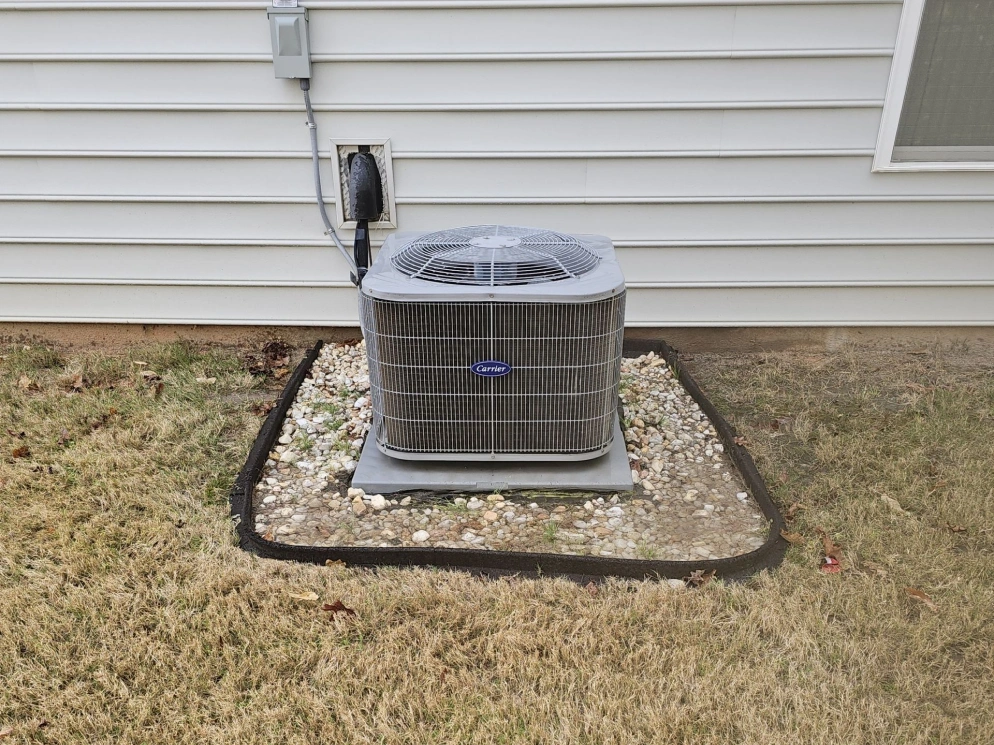
A Carrier condenser after its maintenance visit.
Why these fail in the Carolinas specifically
Our water and our winters
The mineral content in this region’s water is the humidifier’s whole nemesis: it is what the panel exists to capture, what eventually chokes the panel, and what scales the orifices and solenoids when maintenance slips. Combine that with a heating season short enough that humidifiers spend most of the year idle, and you get the classic Carolina failure pattern, units that hibernate eight months and then get asked to perform on the first dry cold week with a panel from three winters ago.
The idle months matter more than owners suspect: water sitting in feed lines and trays through a long off-season leaves deposits exactly where flow needs to happen, and the fall wake-up is when everything either works or announces itself. This is why the panel change belongs in the fall tune-up rather than in January, and why our maintenance customers essentially never meet this page.
The inherited-unit problem
Half the humidifiers we repair came with the house, undocumented and unmaintained, and the new owners discover them mid-January as either a mystery box or a mystery leak. We identify what you actually own, assess honestly whether it deserves rescue, and either restore it to service with a fresh panel and clean water path or tell you plainly that the previous owner’s drum-era relic belongs in the recycling with the eighties.
That verdict comes with the reasoning visible, because inherited-equipment trust is earned in exactly these moments. Plenty of inherited units are fine machines one panel away from service, and plenty are mold farms with electrical cords. Knowing which you own is worth the visit all by itself, and the visit prices like the small job it is.
Repair or retire: the honest fork
When repair wins
Flow-through units of the modern era are simple, durable machines, and most of their failures are consumables and valves, exactly the repairs that make sense at almost any age. A five-year-old unit with a scaled panel and a lazy solenoid is a repair, emphatically, and a fifteen-minute one at that. Even multiple small repairs rarely add up to replacement money on these units, which is refreshing in a trade where that math often runs the other way.
We stock the common panels, valves, and fittings on the trucks through the heating season, which is why most of these repairs end the same visit they started. The 10% teacher and service-personnel discount applies here like everywhere, and no repair this size will ever arrive with a surprise attached, because it goes in writing first like everything else.
When retirement is the kindness
Drum-style units from decades past earn retirement almost on sight: standing water reservoirs with foam drums are maintenance-hungry mold habitat by design, and restoring one is polishing a problem. Units scaled through their entire water path, cracked housings, and humidifiers fundamentally mismatched to the system they serve, bypass units starving on heat pump air, all point the same direction.
When the fork appears, both paths get priced in the same conversation: the honest repair number beside the honest replacement number, with our recommendation and its reasoning stated plainly. The decision stays yours, the pressure stays absent, and whichever path you take gets done properly. That is the whole methodology, and it has not changed since the first page of this site.
The short version
Dry house, check the damper and call. Water anywhere it should not be, close the feed valve and call faster. Most humidifier repairs are quick, cheap, and finished the same visit, and the diagnosis is honest enough to include telling you when the unit deserves retirement instead of rescue.
One upfront diagnostic rate quoted on the phone before anyone drives, the repair priced in writing before it happens, the 10% teacher and service-personnel discount applied like everywhere else, and the fall panel change folded into your maintenance rhythm afterward so this page and your address can stop meeting each other professionally.
Same crew. Same price. Any hour.
No after-dark surcharge and no phone tree. If your system cannot wait until morning, neither do we.
Humidifier repair questions from dry and damp houses alike
My humidifier runs but the house is still dry. Why?
Start with the panel, which is the answer more often than everything else combined: a scaled panel passes water without evaporating much of anything. Behind it, check the damper position, the solenoid actually delivering water, and the humidistat calling at times the system can distribute moisture. We test the whole chain in minutes, and the fix is usually the cheapest item on the suspect list.
There is water around my furnace. Is it the humidifier?
Quite possibly, and it shares the neighborhood with condensate drains, so the visit sorts out which. Either way, water near a furnace is a today problem rather than a someday one: close the humidifier feed valve, towel what you can, and call. The difference between a fitting repair and a cabinet-rust project is mostly measured in days.
How often does the water panel really need changing?
Around here, annually at the start of heating season for most homes, and twice-a-season for households running high targets or hard water. It is a cheap part and a five-minute swap that we fold into fall tune-ups automatically. The panel is the unit’s filter, its wear item, and its most common point of failure, all in one corrugated rectangle.
My unit hums or clicks but nothing happens. What is that?
Usually the solenoid valve announcing its retirement: energized but not opening, or opening but scaled shut downstream. Occasionally it is the transformer or control instead, and the multimeter settles the debate in minutes. It is one of the most common and least expensive repairs on the whole unit, provided the water path behind it has not been marinating in minerals meanwhile.
Can you service the humidifier another company installed?
Of course, and most of the units we service arrived that way. Brand does not matter much in this trade, since the common platforms share their logic, and we carry stock for the panels and valves that cover most of what hangs on ductwork around this metro. If the install itself was the problem, saddle valve, no drain, wrong type for the system, you will get that truth with photos and options rather than a lecture.
Is a musty smell coming from the humidifier?
It can, particularly from drum-era units and from flow-through units whose drains stopped draining. The visit tells us whether a cleaning and drain repair solves it or whether the design itself is the problem, which for standing-water drum units it usually is. Air you humidify is air you breathe, and this is one symptom we recommend never learning to live with.
Should the humidifier be off all summer?
Yes: damper to the summer position on bypass units, and the whole unit idle while the air conditioner spends the season removing moisture instead of adding it. Running both at once is paying two machines to argue with each other. The seasonal flip takes ten seconds, we label it clearly during any visit, and the fall tune-up puts everything back on winter duty right on schedule.
The rest of the humidity aisle
Repair sits between installation and replacement, with the summer moisture story running in parallel next door.
Humidifier Installation · Humidifier Replacement · Dehumidifier Services · Furnace Tune-Up · Emergency HVAC
Want proof before the phone call? The gallery is all real jobs, and the financing page covers the big-ticket math.