
Cooling · Diagnosed by meter, fixed fast
AC repair that starts with the actual problem
Warm air from the vents, a unit that hums but never kicks on, breakers that will not hold, or a system that runs all day and loses ground anyway. Whatever your air conditioner is doing, we find the real cause with instruments, put the fix in writing, and get cold air moving again fast.
We are Zach and Eric Massey, a family HVAC crew out of Fort Mill with 25 years in the trade. We answer 24/7, we charge the same price at midnight as at noon, and we repair every major brand across both sides of the state line.
What a dying AC sounds like before it dies
The warning signs worth a phone call
Air conditioners almost never fail without clearing their throat first. Warm or weak air from the vents while the outdoor unit runs. Short bursts of cooling that stop before the house catches up, which is short cycling and murders both comfort and equipment. A breaker that trips once might be a fluke, but a breaker that trips twice is protecting you from something real. Hissing or bubbling near the refrigerant lines, ice anywhere on the copper, water pooling around the indoor unit, or a power bill that jumped for no reason you can name.
Any of those symptoms is worth five free minutes on the phone. Describe what the system is doing, or hold the phone up to the noise, and we will tell you honestly whether it can wait for a normal appointment or needs a truck tonight. Half the panic calls we take turn out to be a Tuesday-sized problem, and we would rather tell you that for free than let you sweat over it all night.
What actually breaks around here
After 25 years of Carolina summers, the failure list is not mysterious. Capacitors die in the first real heat wave, because heat is exactly what kills them. Contactors pit and stick after years of cycling. Condensate drain lines clog in the humid months and shut systems down through the float switch, which is the single most common no-cool call we run from May to September. Fan motors seize, refrigerant finds a way out through a rubbed line or a corroded coil, and control boards take lightning personally.
The reason our trucks fix most cooling problems on the first visit is that they are stocked around exactly that list. Common capacitors, contactors, motors, and drain tooling ride with us all summer. When your AC quits on the hottest Saturday of July, the difference between fixed today and fixed Thursday is usually whether the part came on the truck.
How an EZ repair visit runs
Instruments first, opinions second
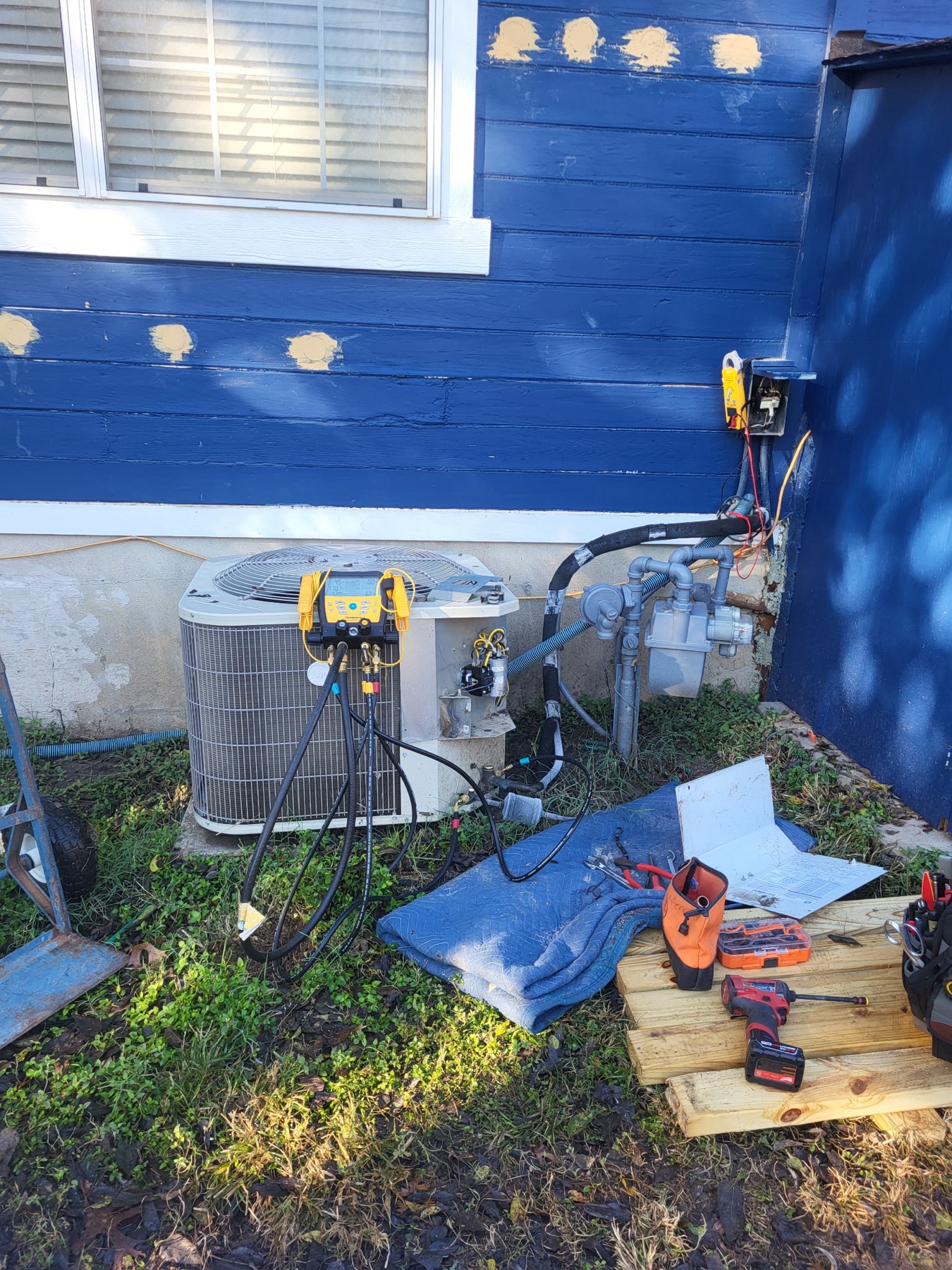
The visit starts with gauges, meters, and temperature probes, never with a sales pitch. We measure refrigerant pressures, electrical draw, temperature split across the coil, and airflow, because those numbers tell the truth even when the symptoms are confusing. A weak capacitor can masquerade as a bad compressor. A clogged filter can impersonate a refrigerant leak. Guessing wrong on either one costs you real money, which is why we do not guess.
Once the cause is nailed down, you get the plain-English version: what failed, why it failed, what it costs to fix, and whether anything else is close behind it. That last part matters. A capacitor that died of heat stress often took the motor’s bearings halfway with it, and telling you now beats surprising you in August.
The number in writing, then the work
You approve the price before a single part comes off the truck, in writing, with no diagnostic fee games and no surprise line items. If the smart move is a small fix, that is what we recommend, and our reviews are full of customers we told to spend less. If the system is old enough that repair money starts looking like a down payment on something better, we lay out both paths honestly and let you decide without pressure.
Then the repair happens, usually the same visit. We test the whole system afterward, not only the failed part: pressures, temperatures, amp draws, and drainage all verified before we pack up. You get the old part if you want to see it, the workspace cleaner than we found it, and a system that is actually fixed instead of merely running for now.

The truck and trailer, loaded for an install day.
Repairing coolers in a climate that hates them
Carolina summers are an endurance test
From late May through September, an air conditioner in the Charlotte metro runs hours that would count as abuse in a northern state. Mid 90s temperatures with soupy humidity mean the system rarely rests, and every weak component gets found out. That is why so many breakdowns cluster in the first heat wave: winter hides the problems, and June finds them all at once.
Humidity is its own repair category here. A system low on refrigerant or starved for airflow stops pulling moisture out of the air long before it stops cooling entirely, which is why a clammy house at 74 degrees is a symptom, and one worth taking seriously. If your home feels sticky even when the thermostat says fine, the system is asking for help.
The repairs that prevent repairs
Some of the best repair work is the kind that stops the next failure. When we are on site for a fix, we look at the system around it: coil condition, drainage, electrical connections, filter situation, airflow. Not as an upsell audit, but because a fixed capacitor next to a coil wearing a blanket of pollen is a return visit waiting to happen, and we would rather tell you the whole story in one trip.
This is also where a maintenance rhythm earns its keep. Customers on spring tune-ups almost never meet us on an emergency basis, because the parts that were about to fail got caught while they were cheap. If your AC has not been looked at since it was installed, the honest advice is to let the repair visit double as the physical it never got.
A field guide to air conditioner noises
Sounds with harmless explanations
A soft click at startup and shutdown is relays doing their job. A low steady hum from the condenser is normal operation, and a brief shudder when the compressor kicks on is common on older units. Water trickling near the indoor unit in humid weather is usually condensate doing exactly what it should. The first warm-up of fall often burns a season of dust off the heat exchanger and smells like it, briefly.
We tell you the harmless list first because half the anxious calls we take land on it, and a two-minute phone conversation beats a service fee for reassurance. When in doubt, call and describe it, or point the phone at the sound. Diagnosing by ear is a real skill and we are unreasonably proud of ours.
Sounds that mean shut it off
Grinding or screeching is metal on metal, usually a motor bearing in its final days, and running it converts a motor replacement into a bigger bill. Repeated rapid clicking is often a relay or control failing, or a compressor trying and failing to start, which cooks windings. Gurgling from the refrigerant lines can mean a leak has left the system low. A burning electrical smell is an immediate stop, every time.
Hissing deserves its own line: refrigerant escaping under pressure sometimes announces itself audibly, and every hour of runtime afterward stresses the compressor. Shut the system down at the thermostat, note what you heard and where, and let the diagnosis start from a healthier baseline. The pause costs you a warm afternoon. Pushing through can cost a compressor.
What AC repair costs with us
Diagnostics carry one simple upfront rate, quoted on the phone before anyone drives, and applied toward the repair when you go ahead with the work. The repair itself gets priced in writing before it starts, the emergency call costs the same as the scheduled one at any hour, and teachers and service personnel take 10% off the whole thing. No trip fees by zip code, no after-hours multipliers, no drama.
If the repair turns out to be big, financing through Optimus is available for qualifying work, and the honest repair-or-replace math conversation is free. We will never let you put a payment plan on a part when the smart answer is a smaller bill.
Want a straight answer first?
Ten minutes on the phone usually tells us plenty. The visit puts real numbers on it, in writing, before any work starts.
AC repair questions, answered straight
My AC runs but the house will not cool. What is that?
The big three are low refrigerant from a leak, a coil choked with dirt or pollen, and airflow problems from a clogged filter or failing blower. All three produce the same complaint and completely different bills, which is exactly why we diagnose with gauges before naming a price. Shut the system off if you see ice on the lines, and call. Running it frozen makes everything worse.
Is it worth repairing a 12 year old air conditioner?
Sometimes, genuinely. A modest repair on a healthy 12 year old system can buy years. A major component failure on the same system usually should not be fixed, because that money works harder inside new equipment with a warranty and a lower power bill. We price the repair, sketch the replacement math, and tell you which way we would go at our own house. The decision stays yours.
Do you charge extra for nights and weekends?
No. The 24/7 line has no emergency surcharge attached, because your compressor did not check the calendar before quitting and charging you extra for bad luck never sat right with us. A Saturday midnight repair costs what the Tuesday afternoon version costs.
Why does my breaker keep tripping when the AC starts?
A breaker that trips at startup usually means the compressor is drawing too much current, often because a start capacitor is weak or the compressor itself is struggling. Resetting it once is fine. Resetting it repeatedly is feeding a fire risk and finishing off the compressor. Leave it off after the second trip and call us.
Can you fix my brand? It is not one of the big names.
Almost certainly. We repair every major brand and most of the minor ones, and the physics inside a condenser does not change with the badge. Parts availability can vary for oddball equipment, and if a part is genuinely unavailable we will say so early instead of stringing you along.
Should I keep repairing or start planning a replacement?
Our rule of thumb, said out loud at kitchen tables daily: if the repair costs a small fraction of replacement and the system is under ten years old, repair without guilt. If repairs are arriving yearly, the unit runs outdated refrigerant, or a major component failed out of warranty, start planning, ideally toward a calm shoulder-season swap instead of an August emergency. We price both paths side by side so the comparison is real.
How fast can you actually get here?
Emergencies usually see a truck the same day and often within the hour, depending on where we are working. One January caller had us at the door in under sixty minutes, and summer no-cool calls get the same treatment. Scheduled repairs book into a window that suits you, and we show up inside it. Fort Mill, Tega Cay, and Rock Hill are minutes from the shop; the edge of the radius adds drive time and nothing else, because the price does not change with the zip code.
If repair is not the whole story
Repairs sit in a family of cooling decisions. When the fix stops making sense, the next honest conversations are replacement and sizing, and when the system is fine but the comfort is not, the problem is often air distribution rather than the equipment.
AC Replacement · AC Installation · Air Balancing · Emergency HVAC · Heat Pump Services
Want proof before the phone call? The gallery is all real jobs, and the financing page covers the big-ticket math.