
Humidity
The moisture in an old York house starts underneath it
York’s older homes and the farmhouses past the town line sit over generous crawlspaces, the kind a person can actually work in. From May through September, Carolina humidity settles into that space, into the ductwork running through it and the framing that holds the floor up, and then it rises into the rooms above. By midsummer the house feels heavier than the thermostat says it should.
We size, install, and service whole-home dehumidifiers across the White Rose City and out along the farm roads, and we read the house before we recommend a machine. Sometimes the answer is a dehumidifier. Other times it is a drain, a duct, or an air conditioner sized wrong for the rooms it serves, and you hear that before anything gets sold.
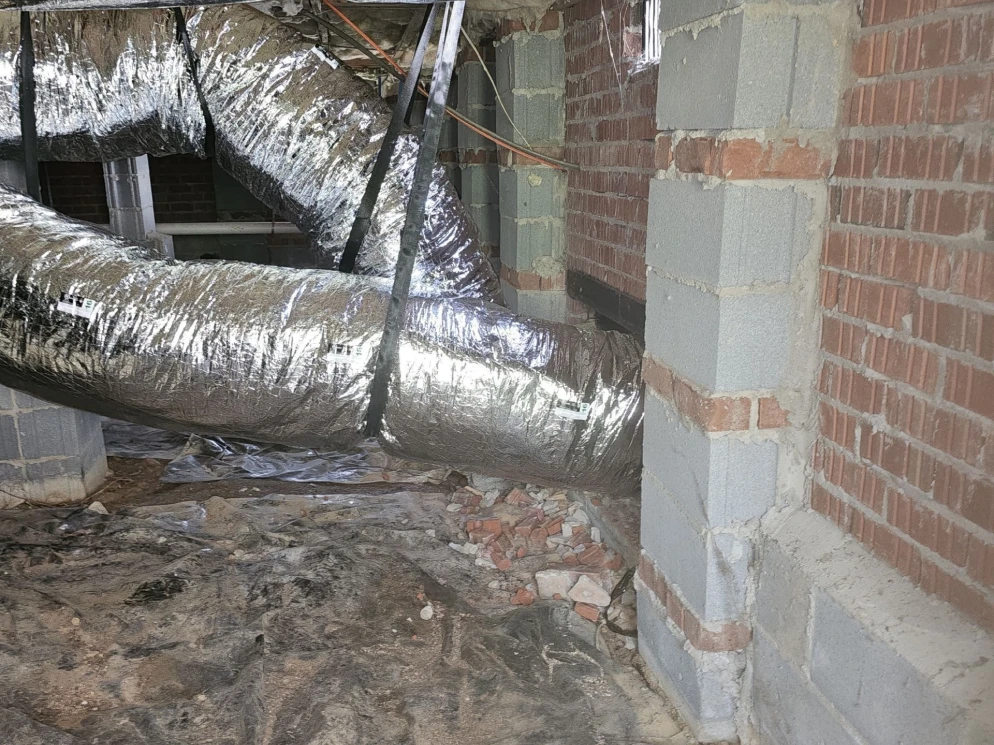
What a wet summer does down in the crawlspace
Ductwork that sweats
Ducts running through a crawlspace carry air cooled far below the temperature of the space around them. When the crawl air is humid, water condenses on every cold surface it can find: the duct jacket, the boots under each register, the plenum, the metal fittings where the insulation has slipped. A summer of that soaks insulation, rusts fasteners, and leaves duct runs sagging under their own wet weight.
The worst of it stays invisible from upstairs. Owners notice a musty smell when the system kicks on, or a floor register that drips, and by then the damage below has been building for seasons. On a first visit we go under the house with a light and a meter before we talk about equipment, and when a run is too far gone, the replacement gets fabricated in our own warehouse and installed in a day.
Framing that never fully dries
The joists and subfloor in an older house were never meant to sit in wet air for five months at a stretch. Wood that holds moisture swells, then shrinks when winter dries it out, and the floors above telegraph that cycle as squeaks, gaps and doors that stick every July. Mold and wood-boring insects favor the same conditions, which is why moisture below the floor deserves attention long before anything upstairs looks wrong.
So we check the ground cover, the foundation vents, any standing water left by the last storm, and how the duct penetrations are sealed. If the first fix is a vapor barrier or a drainage problem outside, we say so plainly, because a dehumidifier fighting a wet dirt floor is a machine set up to lose.
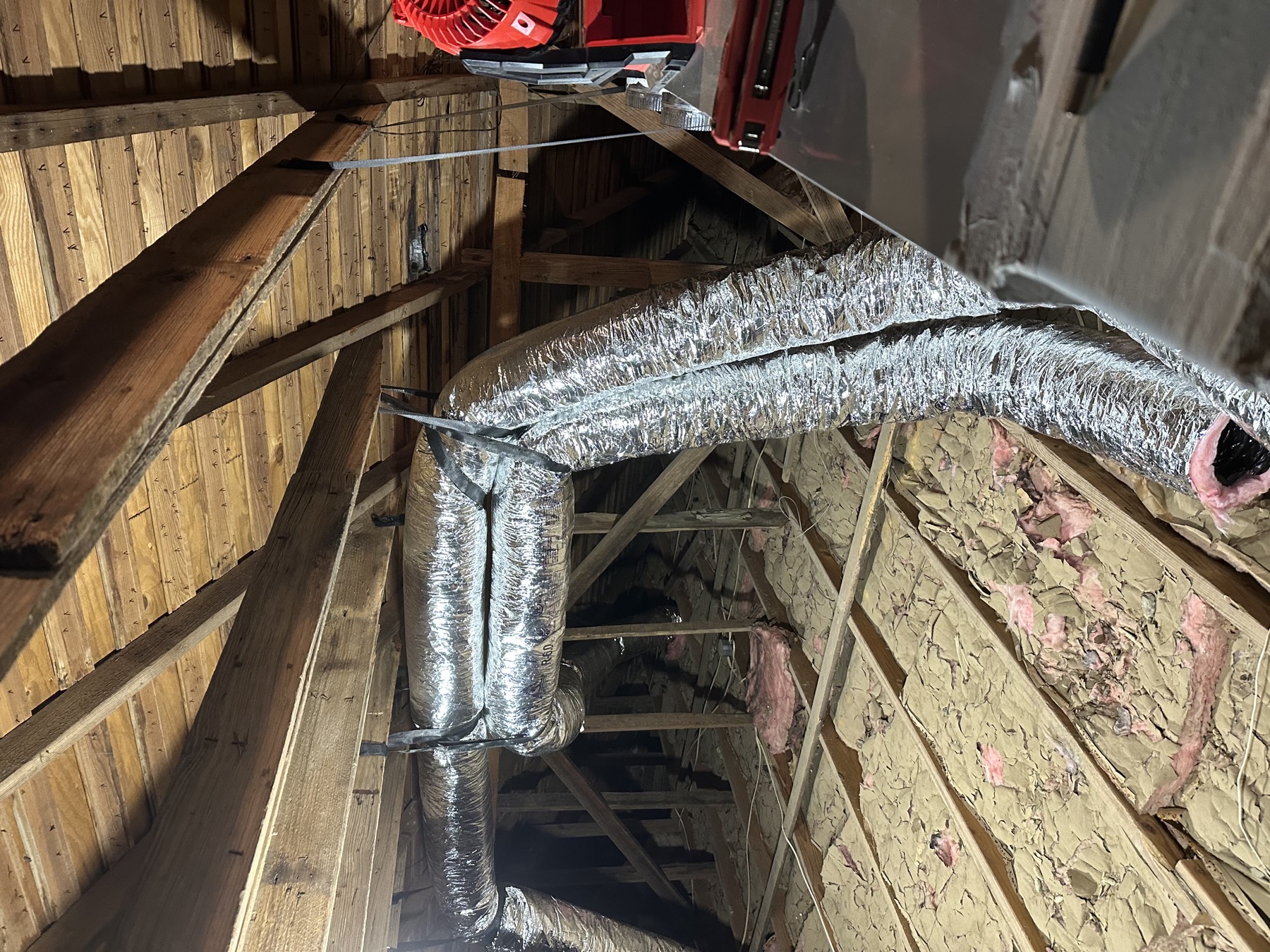
Ductwork runs through attics and crawlspaces alike, and both spaces get walked on a moisture call.
Ducted whole-home unit or a standalone, and how we decide
Tied into the duct system
A whole-home dehumidifier connected to the ductwork pulls air from the return side, dries it, and sends it back through the supply so every room gets the benefit. It runs on its own humidity setting whether or not the house needs cooling, which matters on the mild, muggy days of late spring and early fall when the air conditioner barely runs. It usually sits beside the air handler, in the attic or the crawlspace, out of sight.
That is the right call for most whole-house complaints: a heavy feel in every room, musty air through the registers, condensation on windows. It needs a return and supply path planned properly and a place to send its water, and we lay out both before you see a number.
Farmhouses with additions are their own case. The original house and the addition were often built decades apart, over different floors, and they rarely share one moisture story. We take readings in each part separately, because a ducted unit sized for the whole house can still leave the old rooms damp when the duct runs out to them are long, leaky, or sagging in a wet crawl.
Standalone, for one space
Some problems stay in one place, like a crawlspace that runs wet while the rest of the house is fine, or a workshop on acreage with no ductwork at all. A standalone unit sized for that space, set in it permanently and drained properly, often does more good there than a ducted unit ever would.
The plastic portable from the hardware store is a different animal. It fills a bucket, runs until the bucket is full, and stops quietly on the day you need it most. The standalone units we install are built to run the whole season with a hose or a pump carrying the water off, and they get serviced right along with the rest of the system.
Not sure where the damp is coming from?
Describe what you smell, see and feel, and where in the house it is worst. We can usually narrow it down on a call, and if it takes a look under the floor, that look costs nothing and the honest number arrives in writing.
Sizing the cooling and the drying together
An air conditioner that cools fast and leaves the water
An air conditioner only removes moisture while its coil is cold and running. Size one too big for the house and it reaches the temperature quickly, shuts off, and leaves the water in the air. That happens in older homes where a replacement was picked by square footage alone and never matched to how the house actually gains heat through its walls and holds moisture through its floor.
Sometimes the honest fix is the cooling system itself. When it is near replacement anyway, a load calculation and properly sized equipment can solve most of the moisture complaint without a second machine, and our AC installation work in York starts with exactly that calculation.
The newer builds on York’s edges bring a different version of the same problem. Builder-grade systems often come off a chart for the floor plan with little thought for the lot it sits on, and the year-two checkup is a good time to measure indoor humidity through a real summer cycle. Catching a sticky house then costs far less than living with it until the system is due for replacement.
Sizing the dehumidifier honestly
Dehumidifiers are rated by how much water they pull in a day, and a catalog will happily sell you the biggest figure on the page. An oversized unit costs more to buy and to run than the house requires, while an undersized one runs without stopping and never catches up. We size from the house itself: its volume, how tight or leaky it is, what the crawlspace adds, and how many people live in it.
An old farmhouse with a big crawl and drafty windows needs a different unit than a newer house on the town’s edge with sealed ducts. Getting that right the first time beats living with the wrong machine for a decade, and the main dehumidifier services page lays out the whole service.
Where the water goes, and the spring visit that keeps it moving
A whole-home dehumidifier pulls gallons of water out of the air on a sticky day, and every drop needs a planned route out of the house. Gravity to a proper drain is the best route. Where gravity cannot work, which is common when the unit sits in a crawlspace below the drain line, a condensate pump lifts the water out. What it should never do is drip onto the crawl floor it was put there to dry, or tie into a drain line that already struggles to carry the air conditioner’s water.
Spring is when we get these systems ready, before the humidity season opens in earnest. Filter changed, coil and drain cleaned, pump tested, the humidity control checked against a reading from our own meter, and the ducts and crawlspace walked for anything the winter moved. York’s older homes reward that preparation more than most housing does.
Under the house, the spring walk is where the season’s trouble shows first. A cable installer may have pulled the vapor barrier loose, or the insulation on a duct boot slipped over the winter and has been sweating since the first warm week. Either one takes minutes to set right in April and costs far more by August, when the crawl is at its wettest.
What York homeowners ask about humidity
How do I know if my house needs a dehumidifier?
The common signs are a musty smell, a sticky or heavy feel even when the temperature is right, condensation on windows or ducts, and floors that move with the seasons. A humidity reading settles it. We measure in the living space and under the house, then tell you whether equipment or a simpler fix is the answer.
Is a whole-home dehumidifier better than a portable one?
For a whole-house problem, yes. It treats every room through the ductwork, drains itself, and runs on a humidity setting all season without anyone emptying a bucket. A portable still makes sense for one room or a short-term problem. A permanent standalone unit sits in between and suits crawlspaces and outbuildings.
Can’t my air conditioner handle the humidity on its own?
Often it can, if it is sized correctly and running long enough cycles. On mild, muggy days it barely runs, so moisture builds even when the temperature looks fine. An oversized system struggles the same way in midsummer. We check the AC first, because a sizing or airflow fix sometimes makes a dehumidifier unnecessary.
Does my crawlspace need its own dehumidifier?
Sometimes. If the crawl has a solid vapor barrier and stays reasonably dry, it may not need one. If it has bare dirt, standing water after storms, or sweating ducts, the ground and the drainage usually come first. A dehumidifier does its best work once the obvious water sources are handled.
Where does the water from a dehumidifier go?
Into a drain, by gravity when the layout allows it, or through a condensate pump when the unit sits below the drain line. We plan that route before installation and never leave it draining onto the crawlspace floor. We also make sure it does not overload a drain line the air conditioner already depends on.
How often does a whole-home dehumidifier need service?
Once a year at minimum, ideally in spring before the humidity builds. The filter may need changing more often, depending on the house. The visit covers the coil, the drain path, the pump if there is one, and a check that the humidity control reads true against our own meter.
Will a whole-home dehumidifier make the house feel warmer?
A little, right at the unit. Pulling water out of the air gives off some heat, so the air leaving the dehumidifier runs warmer than the air going in. In the rooms it rarely reads that way, because drier air at the same setting feels cooler, and plenty of households end up nudging the thermostat up a degree. On a ducted install we tie it in so the air conditioner carries that small load when it runs.
The rest of York’s comfort work
Moisture touches nearly every other system in the house, so these pages tend to come up in the same conversation.
Start with the York page for the whole town, then see AC installation, furnace installation, mini split installation and smart thermostat installation in York.
Every photo in our gallery came off a real job site somewhere in York County.