
Humidity
Adding moisture back to a farmhouse that dries out every winter
By January a lot of houses on the western roads feel like a cracker box. Floorboards open up at the seams, a doorknob bites you with static, and somebody wakes up every morning with a raw throat. Heat does that to winter air wherever it comes from, whether that is a propane furnace, a heat pump, or the resistance strips that still carry plenty of homes out here. A whole-house humidifier puts the moisture back through the ductwork you already own, so every room gets it at once.
We are Zach and Eric Massey. EZ Heating and Cooling opened its doors in 2023, and the two of us bring better than 25 years of hands-on HVAC work to every attic and closet we climb into. Our phone gets answered around the clock, and a late call never costs extra.
How a dry house tells on itself in January
Wood, strings and trim
Old pine and oak floors in a farmhouse shrink as the air dries, and the gaps between boards open wide enough to catch a fingernail. Interior trim pulls apart at its joints. Doors that stuck all summer suddenly swing loose. If there is a piano in the front room or guitars hanging on the wall, they slide out of tune over a few weeks and come back in spring, which is the instrument reporting the same thing the floor is.
None of that is damage yet, but wood that swells and shrinks hard every year eventually checks and splits. Holding the air at a steadier level through the heating months slows that cycle down.
People, pets and the hygrometer
Dry sinuses, cracked knuckles, nosebleeds in the kids, and the jolt off the couch blanket are the household version. Plenty of folks blame the furnace, and in a way they have a point: warming winter air lowers its relative humidity, so every heating cycle leaves the house a little drier than the air that came in.
We carry a hygrometer and read the humidity in several rooms on the first visit, along with the outdoor conditions that day. Numbers settle the question faster than hunches, and sometimes they show the house is fine overall and the trouble is one room with a space heater running all day.
Bypass, fan-powered or steam, matched to how the house is heated
Furnace homes and propane heat
A bypass humidifier is the simplest whole-house type. It mounts on the supply or return side of the furnace, and a short duct sends some warm air through a wetted water panel and back into the system. It has no motor of its own and leans on the furnace’s heat to evaporate the water, which makes it a natural fit for a propane or gas furnace putting out genuinely hot air.
A fan-powered unit carries its own small blower, so it skips the bypass duct and moves more air across the panel. That helps where the mechanical closet is tight, or where a bypass run would have to snake around framing in an older house.
Heat pumps and electric strips
Heat pump air feels warm on the hand but runs well below furnace temperatures, and evaporative humidifiers lose much of their output on that milder air. For those homes a steam humidifier usually makes more sense: it boils water in its own canister and injects the vapor into the duct, so its output does not depend on how hot the supply air is.
Steam units draw more electricity and need a dedicated circuit, which we check at the panel before recommending one. If the house runs a heat pump with gas backup, we look at which half of that pairing carries most of the winter before choosing.
Water line, drain and the attic in January
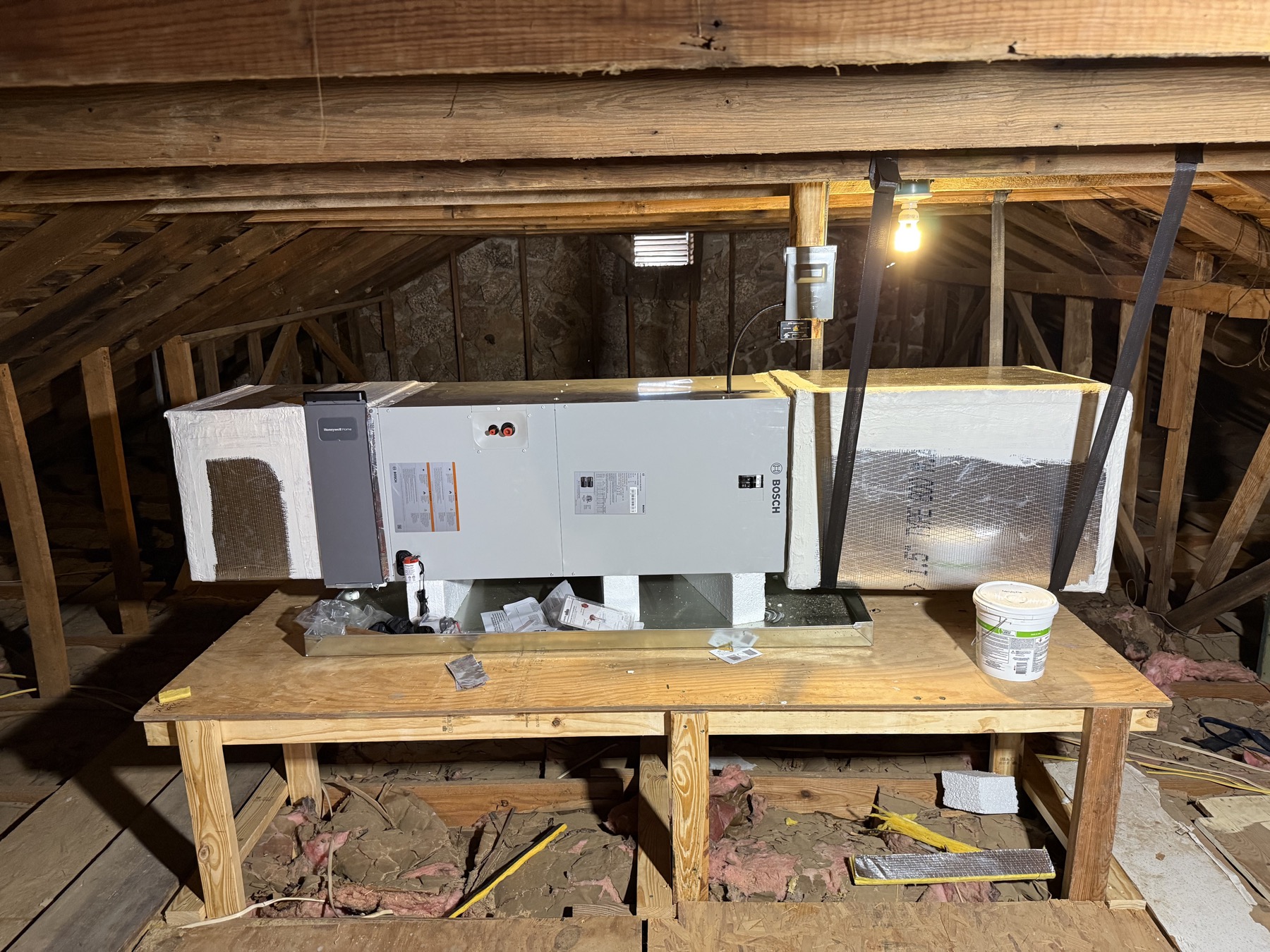
Every whole-house humidifier needs a water supply, and most need a drain line too. In a closet install that is short work. Out here, though, a lot of air handlers sit in attics like the one in the photo up top, and an attic in January drops well below freezing. A water line run through that space gets insulated, routed along the warmer side of the framing where possible, and fitted with a shutoff you can reach without crawling across the joists. The drain gets real slope to a place where water can actually go, never just dumped onto the insulation.
Well water is the other farm-country wrinkle. It often carries a heavy mineral load, and those minerals stay behind on the water panel or inside a steam canister every time water evaporates. We look at your water before picking a unit and tell you plainly how often the pad or canister will need changing on a well. Our humidifier installation overview walks through how we handle every install, on city water or a well.
Setting the humidistat so the glass stays clear on cold mornings
Morning windows as the gauge
More moisture is not always better. When the temperature outside falls hard, the inside of a window pane gets cold enough that humid indoor air condenses on it, and the older single-pane or metal-frame windows in a farmhouse sweat long before newer glass does. Left alone, that water runs down into the sills and stains the wood.
So the setting comes down as the weather turns colder. We show you where to start, what to look for on the glass first thing in the morning, and how to back it off a notch when fog shows up in the corners.
Controls that adjust themselves
Many current humidifier controls take an outdoor temperature sensor and lower the target automatically on the coldest nights, which takes the fiddling away for owners who would rather not think about it. On homes with a smart thermostat, the humidifier can often be wired to it, so one screen runs heat and moisture together.
Either way, we wire the humidifier so it only runs while the blower is moving air. A panel that stays wet with no airflow across it is how mildew and mineral buildup get their start.
Why a portable in the hallway never reaches the back bedroom
The trouble with one room at a time
A tabletop or console humidifier works for the room it sits in. A farmhouse with a center hall, a kitchen ell and two or three additions tacked on over the generations is a long walk for moisture, and the far rooms stay dry while the room with the unit turns clammy. Then comes the refilling twice a day, the white dust from well water on every dark surface, and the tank that grows things if it sits.
A whole-house unit feeds every supply register the system reaches, holds one setting for the whole floor plan, and draws its own water. Nobody carries a jug up the stairs at bedtime again.
Fitting it to the system already there
A humidifier is only as good as the ductwork carrying its moisture. Long runs out to added-on rooms, crushed flex in the attic, or a single return pulling mostly from one end of the house all limit how evenly the air gets spread. We look at those first, and we say so if a duct fix belongs ahead of the humidifier.
Any collar, bypass duct or transition the install needs is measured on the first visit and built in our own warehouse beforehand, so the work itself usually wraps up in one trip. If the furnace under it is near the end, our furnace replacement page for Hickory Grove covers that conversation, since a new humidifier belongs on a cabinet with years left, not one with a single winter in it.
Want the dry rooms read before February?
One visit covers humidity readings room by room, a look at your heat source, water supply and drain routing, and an honest number for the unit that fits. You get it in writing, with no push to add anything else.
What farm-country owners ask before adding a humidifier
Will a whole-house humidifier work with my heat pump?
Yes, though the type matters. Heat pump air runs cooler than furnace air, so bypass and fan-powered units evaporate less water on it. A steam humidifier makes its own vapor and keeps its output up regardless of supply temperature, which is why we usually recommend steam for heat pump and strip heat homes.
Which is better, a bypass or a fan-powered humidifier?
Both use a wetted water panel. A bypass unit borrows the furnace’s airflow through a short duct and has no motor, so it is simple and quiet. A fan-powered unit has its own blower and needs no bypass duct, which helps in tight closets. Your furnace, closet and ductwork decide which one fits.
We are on well water. Is that a problem for a humidifier?
Not a problem, just a maintenance question. Minerals in well water stay behind as the water evaporates, so pads scale up and steam canisters collect deposits sooner than they would on city water. We look at your water first and tell you how often to expect a pad or canister change.
Can a humidifier go on an air handler in the attic?
It can. The water line gets insulated and routed away from the coldest spots, a reachable shutoff goes in, and the drain is sloped to a proper outlet. An unconditioned attic freezes in January, so we plan the plumbing for that before anything gets mounted.
How do I keep the windows from sweating once it is installed?
Lower the humidistat as the weather gets colder. Cold glass condenses moisture, and older windows show it first. We show you the morning check on the glass and how far to back the setting off, or we fit a control with an outdoor sensor that adjusts the target on its own.
Why not just buy a couple of portable humidifiers?
Portables humidify the room they sit in and leave the far end of a long house dry. They need refilling daily, and well water leaves white mineral dust on the furniture. A whole-house unit feeds every register the system reaches from one setting and its own water line.
Can I finance a humidifier or get a discount on it?
Yes. Optimus Financing can cover a humidifier installation, on its own or alongside new equipment. Teachers and service personnel take ten percent off. Bring either one up on the first visit and it shows on the written quote.
Next door to this page in our Hickory Grove work
Moisture is one part of how a farm-country house gets through the winter. The rest of our west end work sits close by.
The Hickory Grove page covers the whole of our farm-country service. If a humidifier you already own stopped doing its job, start with humidifier repair. The heating side lives on furnace replacement, shops and barn offices on mini split replacement, and field dust and pollen on air purification systems.
Curious how our installs look up close? The gallery shows real jobs, shot on site by our own crew.