
The crawlspace under your house is quietly eating your ductwork
Nobody thinks about their crawlspace. That is basically its job description: a dark, low, spider-adjacent zone under the floor that exists so pipes and ducts have somewhere to live, visited roughly never. We understand completely. We also spend a lot of our working lives down there, and we need to tell you what we keep finding, because in this part of the Carolinas the crawlspace is where duct systems go to die slowly.
Between the river bottoms, the creek lines, and a climate that runs humid from May through September, the ground under thousands of local homes stays damp most of the year. Damp air fills the crawlspace, condensation forms on every cool surface, and the duct system, the lungs of your whole HVAC setup, sits down there soaking in it season after season. The equipment upstairs gets all the attention. The ductwork underneath quietly determines whether that equipment’s work ever reaches your rooms.
The short version
- Damp crawlspaces destroy duct insulation season by season, rust the metal runs, drop them onto wet ground, and leak the air you paid to condition straight into the dirt.
- A healthy system attached to dying ducts runs long, costs more, and cools unevenly. It looks exactly like tired equipment from the hallway. It is not, and the difference is a much cheaper fix.
- The fix sequence is drainage and sealing first, duct repair second, dehumidification only where readings justify it.
- We fabricate replacement ductwork in our own warehouse, then install it sealed and suspended, up off the damp ground, which is how a whole-home duct replacement happens in one day instead of a week.
What the damp actually does down there
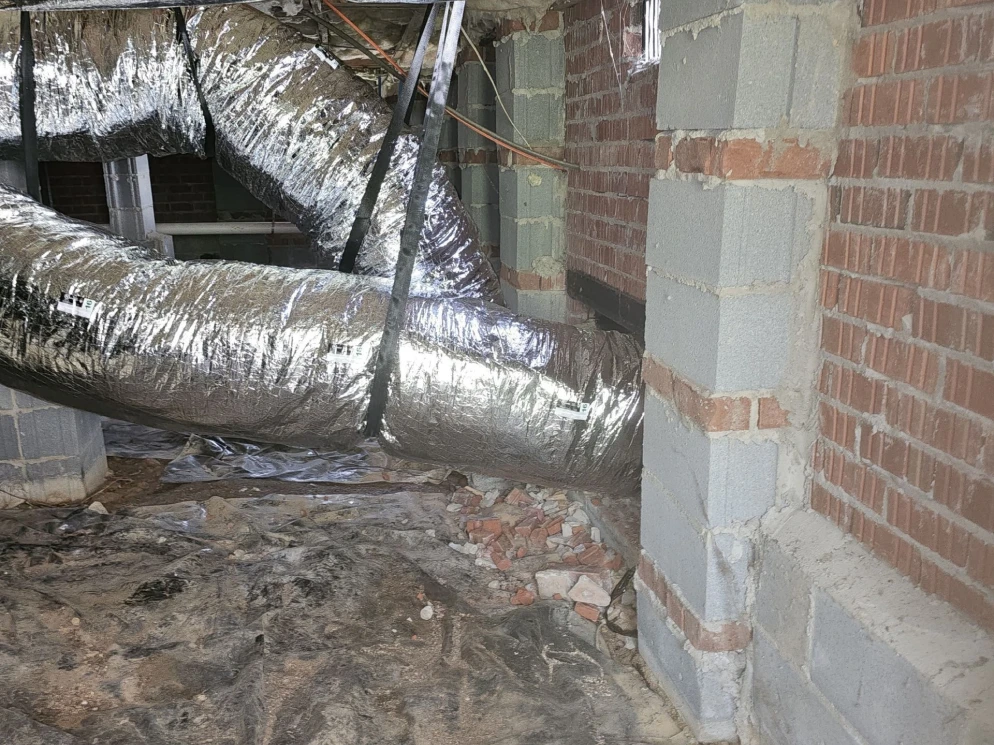
Flexible duct wears a jacket of insulation with a thin plastic skin. In a damp crawlspace, condensation forms on that skin every cooling season, because the duct is full of cold air and the crawlspace is full of warm wet air, the exact recipe for a sweating glass. Year after year, the moisture degrades the jacket, the insulation sags away from the duct, and eventually the runs are wearing soggy, slipping coats that insulate almost nothing.
Metal components fare no better. Sheet metal trunks and boots rust from the outside in, hanger straps corrode and drop runs onto the wet ground, and tape joints let go as adhesives age in the humidity. A duct lying in ground contact wicks moisture continuously, and its insulation value is functionally gone even where it looks intact from above.
The result is a duct system that leaks conditioned air into the crawlspace and soaks up heat it was supposed to keep out. You paid to cool that air, and a meaningful share of it never makes it past your own floor. In the worst systems we crawl, the dirt is getting better air conditioning than the back bedrooms.
The symptoms upstairs that start downstairs
The cruel part is that duct failure impersonates equipment failure. The system runs longer to deliver the same comfort, so the power bill climbs. The far rooms lose supply pressure first, so the house goes uneven, hot bedrooms at the end of the run, a thermostat hallway that feels fine. Owners understandably conclude the aging unit is losing its edge, and more than a few have been sold new equipment that inherited the same dying ducts and changed nothing.
Duct leakage also unbalances the house itself. Supply leaks dump air out, return leaks suck crawlspace air in, and either one shifts pressure in ways that pull outside air, and outside humidity, through every gap in the floor. That is how a duct problem becomes a clammy-house problem and a dusty-house problem at the same time, and why musty smells so often ride the vents on startup.
The tell we listen for on the phone: comfort that faded gradually over years, uneven rooms that used to match, bills creeping up without the weather changing, and any mention of a musty note when the air kicks on. That cluster says look under the floor before anyone quotes equipment, and the look costs a service visit, never a commitment.
Why this region gets it worse
Local geography does the damage here. The Catawba and its feeder creeks thread this whole map, and the low ground holds water long after rain moves through. Crawlspaces in creek-bottom neighborhoods hold damp for weeks at a time, and even the higher ground runs humid all summer because the air itself arrives loaded. A crawlspace that never quite dries is the default condition in big stretches of our service area, from the river towns clear out to the farm roads.
Construction age plays its part too. Older homes were built with ventilated crawlspaces on the theory that airflow would dry them out, and in this climate the vents mostly invite more humid air in to condense on cool surfaces. Newer homes trend better, but plenty were finished fast during boom years, with duct runs strapped quickly, barely suspended, and inspection-minimum sealing that starts leaking early.
None of this is the homeowner’s fault, and none of it is visible from the hallway. Which is exactly why it compounds for years: the one part of the house nobody looks at, failing in the one way nobody would see.
The fix, in the only order that works
Everything starts with water. Before any duct gets replaced, the crawlspace has to stop being a swamp: grading and drainage corrected where water collects, gutters and downspouts actually moving roof water away, and a ground vapor barrier sealing the biggest moisture source in the space. Skipping this step and installing beautiful new ductwork into the same wet environment just schedules the same failure for a few years out.
Then the duct system gets honest triage: what can be resealed and re-insulated, what needs replacing outright, and what should be rerouted or resuspended up off the ground. Joints get sealed with mastic rather than hope, runs get hung properly, and insulation appropriate for a humid crawlspace goes on. Where readings show the space still holding moisture after the source work, dedicated dehumidification earns its place, sized to the space, with numbers to justify it.
We take moisture readings before and after every crawlspace job, and we share them, because this is invisible work and the numbers are how you know it happened. The comfort difference upstairs, though, is rarely subtle: rooms that match again, run times that shrink, and that musty startup smell gone for good.
The warehouse part of the story
Here is the piece of our process that surprises people: when a duct system needs real replacement, we build it in our own warehouse first. Measurements come from your actual crawlspace, fabrication happens on our bench where the cuts are square and the sealing is done right, and the finished runs arrive test-fitted and ready to hang. The alternative, fabricating piecemeal in a thirty-inch crawlspace by headlamp, is how the sloppy joints that started this article get made.
The practical difference for you is speed and quality at once: a whole-home duct replacement that installs in a day instead of a week of your house being a job site, with sealing done on a bench where it can be done thoroughly. It is one of the quiet reasons our duct jobs hold their readings years later, and honestly, it is some of the work we are proudest of, even though nobody ever sees it.
If you have wondered why we photograph so much crawlspace work for the gallery, that is why. It is the least glamorous before-and-after we own, and the most honest.
What you can check without crawling anywhere
You do not need coveralls to gather the first clues. Compare a far bedroom’s airflow to the room nearest the air handler, weak versus strong is data. Sniff the first thirty seconds after the system kicks on, musty means crawlspace air is riding along. Look at your power bills year over year for the same months. Walk the house perimeter after a rain and note where water stands. Peek through a crawlspace vent with a flashlight and look for sagging silver runs or anything lying on the dirt.
Any two of those clues together justify the real inspection, which we do with moisture meters, a camera, and no obligation attached. The report tells you what is actually down there, what order the fixes should go in, and what each step costs, in writing. Plenty of inspections end with reseal three joints and fix a downspout, and we are entirely happy delivering that news.
The one thing we would ask: do not let anyone quote you new equipment for an old-duct problem without looking under the floor first. The system is only ever as good as the ducts it breathes through, and the cheapest capacity upgrade in this whole industry is getting back the air you already paid to condition.
Quick answers
How do I know if my ducts leak without an inspection?
The house tells on them: uneven rooms, weak flow at far vents, musty startup smells, bills that creep without weather changes, and excessive dust are the classic cluster. A duct system can also be pressure-tested to measure leakage directly, which turns the suspicion into a number and the number into a fix list.
Is duct cleaning the same thing as duct repair?
Different jobs entirely. Cleaning removes dust from inside ducts that are structurally fine, and it has its place. Repair fixes leaks, crushed runs, failed insulation, and ground contact, which is where the comfort and money actually go. Plenty of homes get sold cleaning when what the readings would ask for is sealing, so diagnosis first, always.
What does crawlspace duct work roughly cost?
It spans widely because the scope does: resealing a few joints is a modest service visit, a full fabricated replacement with drainage work is a real project with financing available through Optimus. Every quote itemizes in cheapest-first order so you can stage the work sensibly, and the inspection that produces the quote carries no obligation at all.
Can I just close my crawlspace vents in summer?
Tempting, and partially backwards either way. Open vents admit humid air, closed vents trap ground moisture, and the real answer is controlling the moisture source with a vapor barrier and drainage, after which the vent question matters far less. Sealed and conditioned crawlspaces done properly work beautifully here, but the sequence still starts with water, never with vents.
Will new ducts really lower my power bill?
If the old ones were leaking into the crawlspace, yes, and sometimes dramatically, because you stop conditioning the dirt. The honest answer for your house comes from the leakage test: the percentage lost tells you the ceiling on the savings. We would rather show you that number first than promise you one.
Do you do this work in winter too?
All year, and shoulder seasons are actually ideal: mild weather, calm schedules, and the crawlspace at its most cooperative. Duct projects planned for spring or fall install faster and price calmer than anything discovered mid-July. If this article sounds like your house, the inspection this month beats the emergency in August.
When did anyone last look under your floor?
One inspection with a moisture meter and a camera tells you exactly what the crawlspace has been doing to your ductwork, in numbers and photos, with the fixes listed cheapest-first and priced in writing. No obligation, no drama, and quite possibly the best money-per-comfort phone call you can make from anywhere on this website. The dirt has had your air long enough.
Call (803) 573-2473or send us the detailsWant proof first? The gallery is all real jobs.