
Controls
The thermostat on your wall should know how your house actually runs
Most smart thermostats come out of the box set for a household nobody lives in. The schedule assumes everyone leaves at eight, the equipment settings are generic, and the early recovery feature is free to call on the most expensive heat in the building just to hit a number before breakfast. Hang one in a York hallway that way and the app looks great while the thermostat quietly argues with the system it is supposed to run.
We install and configure smart thermostats across the town, from veteran systems in the blocks around the old courthouse to the builder-grade setups on the newer edges. The install includes the half most people skip: the wiring at the air handler or furnace, the settings that match your equipment, and a test of every stage before we pack up.

Old wiring decides what can go on the wall
The wire that may not be there
A smart thermostat needs steady power, and it gets that power through a common wire, the one the trade calls the C wire. Thermostats from the era when many of York’s veteran systems went in never needed one. They ran on batteries or a mercury bulb, so the cable in the wall often carries just enough conductors for heat, cooling and the fan, with sometimes a spare folded back behind the plate and never used.
When there is a spare, we connect it at both ends and the job stays simple. When there is not, the honest options are pulling a new cable, fitting an adapter at the equipment that frees up a conductor, or choosing a thermostat designed to live without one. Models that borrow power through the other wires can make relays chatter and equipment behave strangely, so we check before anyone buys anything.
Why the real work happens at the air handler
Half of every thermostat installation happens away from the wall. The control wires end inside the air handler or furnace cabinet, on a terminal board, and that is where a common gets connected, where the reversing valve and backup heat terminals on a heat pump get confirmed, and where splices from earlier jobs turn up. The photo up top shows the kind of junction we mean, with control wires joined at the top of a new air handler in a hallway closet.
In houses that have lived through a few renovations, that terminal board tells the true story. Wire colors that ignore the convention, a stage that was never connected, a jumper someone added to make a symptom go away. We read all of it before mounting anything, because a handsome thermostat cannot run a stage nobody wired.
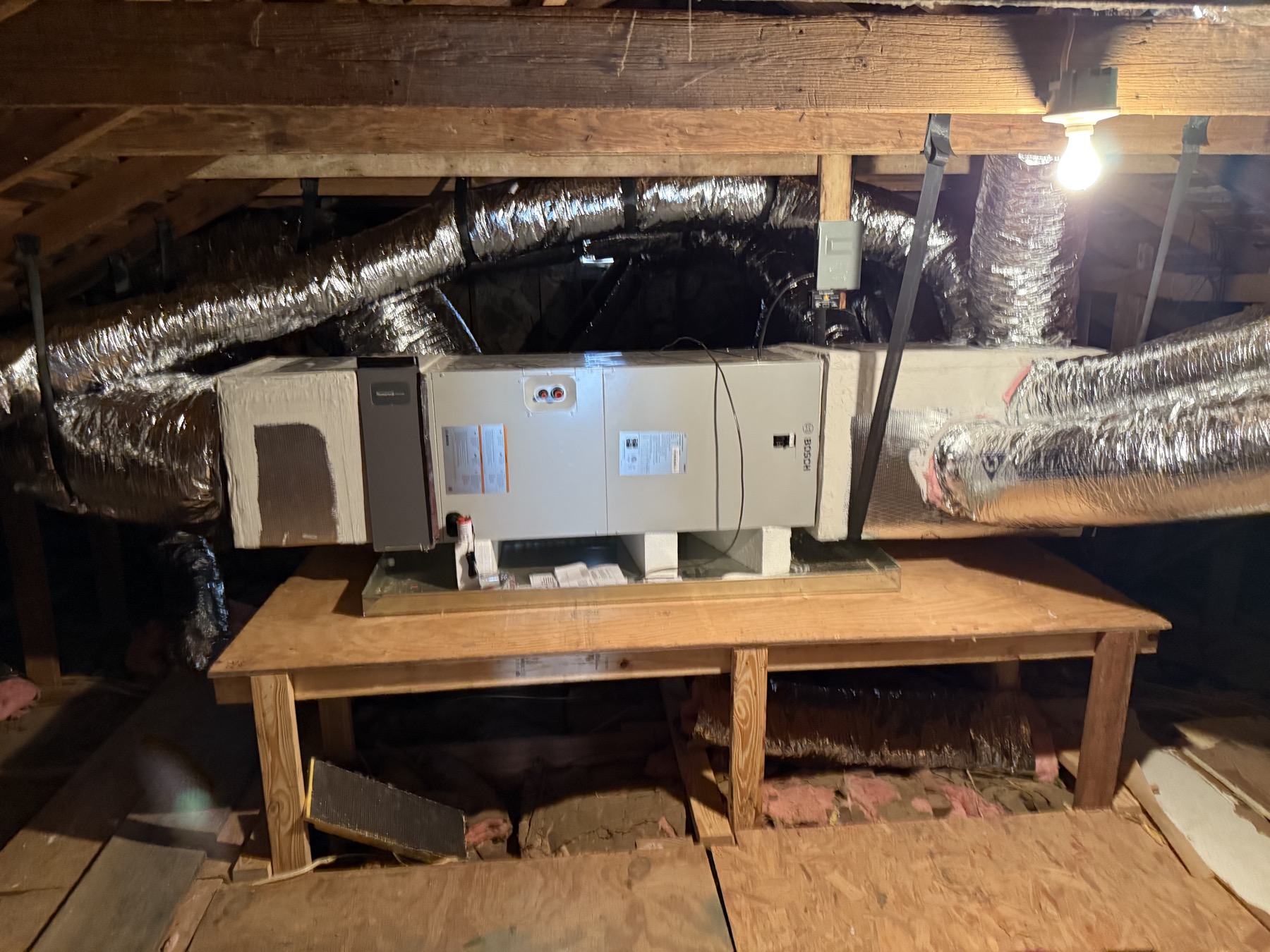
Every control wire ends at equipment like this, so every install starts at the equipment.
Heat pump settings that keep the strips in reserve
After a strips-to-heat-pump conversion
Plenty of York homes have traded electric strip heat for a heat pump, and the bill math on that change is dramatic when the controls cooperate. They do not always cooperate. A thermostat left on a generic setting may treat the strips as the first answer instead of the last, may never tell the reversing valve which way to shift, or may not know a heat pump is out there at all.
We set the equipment type, the reversing valve terminal, the number of stages, and an auxiliary heat lockout so the strips only wake when the heat pump truly cannot keep up. Early recovery gets the same scrutiny. A thermostat racing to reach a morning setpoint ahead of schedule will happily call the strips to win that race, and you pay for the win. Our smart thermostat installation page has the full service if you want the longer version.
Two systems, one staircase
Two-story houses and farmhouses with additions often run two systems, and two smart thermostats bought separately have no idea the other exists. On a spring afternoon the upstairs calls for cooling while the downstairs calls for heat, both units run hard, and the stairwell turns into the border between two climates pushing against each other.
We line up the schedules and setpoints so the floors agree, keep the upstairs from cooling the whole house down through an open stair, and tune the fan settings so one system is not pulling the air the other just conditioned. When both thermostats come from one maker they can share sensors, which helps. Mostly it is settings, and settings cost far less than a season of extra run hours.
Wondering if the thermostat is even the problem?
Tell us what the house is doing and what the screen shows. A phone call often sorts out whether it is a setting, a wire, or the equipment, and if it needs a visit, the honest number is in writing before work starts.
New edges and veteran blocks need different installs
Builder-grade thermostats on new construction
The newer builds on York’s edges usually arrive with whatever thermostat came in the builder’s package: basic, functional, and often configured by whoever was finishing the job that week. We regularly find heat pumps set up as conventional systems, fans left running around the clock, and schedules nobody touched after the closing.
Swapping in a smart thermostat there is a good moment for the year-two checkup the house is owed anyway. The staging gets set correctly, the system gets checked against what the buyer actually paid for, and the new control starts life working from the right assumptions instead of a guess.
The household’s own habits matter as much as the equipment. A home with a night-shift worker wants a different program than a retired couple who are in all day, and a rental sitting between tenants wants another one again. The factory default suits none of them. We ask who is home and when, set the program to match, and show someone in the house how to change it without calling us.
Veteran systems that want a gentle hand
York runs veteran equipment at unusual density, systems past fifteen years serving homes past a hundred. A smart thermostat can help those systems, mainly by ending the big swings that make old equipment work hardest. It can also hurt them, when aggressive setbacks force a long, hard recovery every single morning on a compressor that would much rather run steady.
On older systems we keep setbacks modest, set minimum off times that protect the compressor, and leave the owner with a schedule they can read without the app. A jumper left on the terminal board by an earlier installer tells us something too, usually that a stage or the fan got wired around instead of set up, and we sort that out before the new control goes on the wall.
When we tell you the thermostat is not the fix
A new thermostat is the easiest thing in the house to sell, which is exactly why we are careful about selling one. A good share of calls that start as thermostat complaints end somewhere else entirely: a clogged filter, a weak capacitor, a frozen coil, ductwork sending half the air to one bedroom, a return too small for the system. Swap the thermostat in those houses and the owner gets a new screen, the same problem, and a little less faith in the trade.
So the visit starts with the system. We confirm the equipment answers a call for each stage, measure supply and return temperatures, and look at airflow before we talk about the wall. If the old thermostat is fine and the trouble is a part, we fix the part and tell you to keep the thermostat. If the system and the control both need work, you see both written down side by side, and the choice is yours.
Second opinions are free here. If another company blamed the thermostat for a failure, or told you a new one would cure a house that never cooled right, we will check that claim with instruments and give you a straight read on what the instruments show.
Thermostat questions York households ask us
Do I need a C wire for a smart thermostat?
Most smart thermostats want one, because it gives them steady power, and older York homes often do not have it. We look for a spare conductor first. If there is none, we run new cable, add an adapter at the air handler, or recommend a model that works without one, and we settle which before you buy.
Can a smart thermostat run my heat pump correctly?
Yes, once it is configured as a heat pump. That means the right reversing valve setting, the correct number of stages, and an auxiliary heat lockout so the strips stay a backup. Plenty of installs we revisit were left on a generic setting, which works on mild days and turns expensive on cold ones.
Will a smart thermostat lower my power bill?
It can, mostly by keeping the system resting while nobody is home and by stopping strip heat from running when it has no reason to. It cannot fix a failing part or leaky ductwork. If your bill problem lives somewhere else, we tell you that before you spend anything on a thermostat.
Can you install a thermostat I already bought?
Usually, yes. Send us the model and we will check it against your wiring and equipment before the visit. If it is a poor match for your system, such as a model that needs a wire your house does not have, we lay out the options plainly instead of forcing it to work.
Our upstairs and downstairs systems fight each other. Can that be fixed?
Most of the time, with settings. We align the schedules and setpoints, adjust fan behavior, and make sure neither system is chasing air the other one already moved. If the fight really comes from ductwork or a system sized wrong for its floor, we show you that separately so you can decide what to do.
Should the thermostat change when the whole system gets replaced?
Usually, because new equipment often has stages, variable speeds, or communication features an old thermostat cannot use. When we install a system, the control is part of the plan from the first walkthrough. Some brands run best on their own matching thermostat, and when that is the case we say so up front.
Can one smart thermostat run the mini split too?
Usually not by itself. A ductless mini split takes its orders from its own remote or wall controller, and a standard smart thermostat talks to the central system only. Some mini split brands sell a wired controller or an adapter that lets the head answer a thermostat call, and we check what your model supports before promising anything. Where it works, we set both so they are not fighting over the same room.
Where a thermostat job usually leads in York
The thermostat sits at the end of every system in the house, so it comes up in nearly every other job we do in town.
The York page covers the whole town, and the other York pages take on AC installation, furnace installation, mini split installation and dehumidifier services.
Prefer to see the work first? Our gallery is real installs from real York County houses, photographed by the crew that did them.