
Lancaster County · The corridor’s pattern file, memorized
Indian Land HVAC, from the crew that memorized the entire 521 corridor
Indian Land grew faster than nearly anywhere in either Carolina, and its mechanical destiny came pre-installed with the streets: the same handful of builder-grade systems repeated across a full decade of subdivisions along the 521 corridor, all aging on the same curve together, with the first waves now past their warranties and deep into the statistically interesting years. Few towns anywhere carry a more predictable HVAC story, and predictability becomes real leverage for the homeowner who hires the crew that took the trouble to memorize it.
We are that crew, fifteen minutes away in Fort Mill: the corridor’s common failures stocked on every truck before they happen, its builders’ habits documented subdivision by subdivision over years of identical repairs, and its townhome quirks handled so routinely they qualify as scheduled. Same-day standards, hour-class emergency response, written prices at every address, and the 24/7 no-extra-fee line covering the whole panhandle from the state line to the far side of Del Webb.

The corridor, fifteen minutes out
Where we work
The whole panhandle: the 521 corridor’s subdivisions and townhome communities, the Del Webb and Sun City orbit with its active-adult neighborhoods, the newer streets pushing toward Van Wyck, and the commercial spine that serves it all. Indian Land sits practically next door to Fort Mill, sharing commutes and school traffic, and its response times match our home-county standard outright.
The county page holds the wider Lancaster story and Van Wyck carries the quieter panhandle ground next door. This page belongs to the corridor itself, which generates enough mechanical work to deserve it.
The short version
The fastest-growing strip in the Carolinas, served at genuine home-county speed by the crew that knows its equipment by first name, model number, and usual cause of death. Written prices at every address, trucks stocked for the corridor’s specific patterns, and zero drama at any point in the transaction.
The pattern file, and what it buys you
Shared equipment, shared destiny
Volume construction made the corridor’s HVAC a massive repeated experiment: identical systems installed the same construction season across whole subdivisions at once, aging in perfect formation ever since. Year eight opens capacitor-and-board season on schedule, the low-refrigerant calls cluster wherever the factory brazing was rushed that quarter, and year twelve starts the replacement wave that moves street by street with the regularity of an actual schedule, because functionally that is exactly what it is.
For diagnosis, the pattern translates directly into speed: we service your system’s identical siblings somewhere along the corridor weekly, the trucks stock exactly what this equipment generation breaks, and most repairs finish on the first visit because the failed part was already riding aboard. For replacements, the pattern is context: quotes arrive with the honest history of what the matching units nearby have been deciding, which turns a stressful purchase into an informed one.
The warranty-cliff years
The corridor’s first wave is now past its builder warranties, which changes the homeowner’s position entirely: repairs that were phone calls are now decisions, and the year the warranty ends is exactly when the honest inspection earns its keep. One thorough tune-up maps where your system sits on the curve, what the next likely failure costs, and whether the replacement math has begun its approach.
The active-adult neighborhoods deserve their own dedicated sentence: the Del Webb-orbit households run their systems harder in both seasons than the corridor average, value reliability over absolutely everything else, and benefit most visibly from the twice-yearly rhythm that converts mechanical surprises into scheduled line items. A large share of our corridor maintenance calendar lives in exactly those streets, by their own excellent judgment.
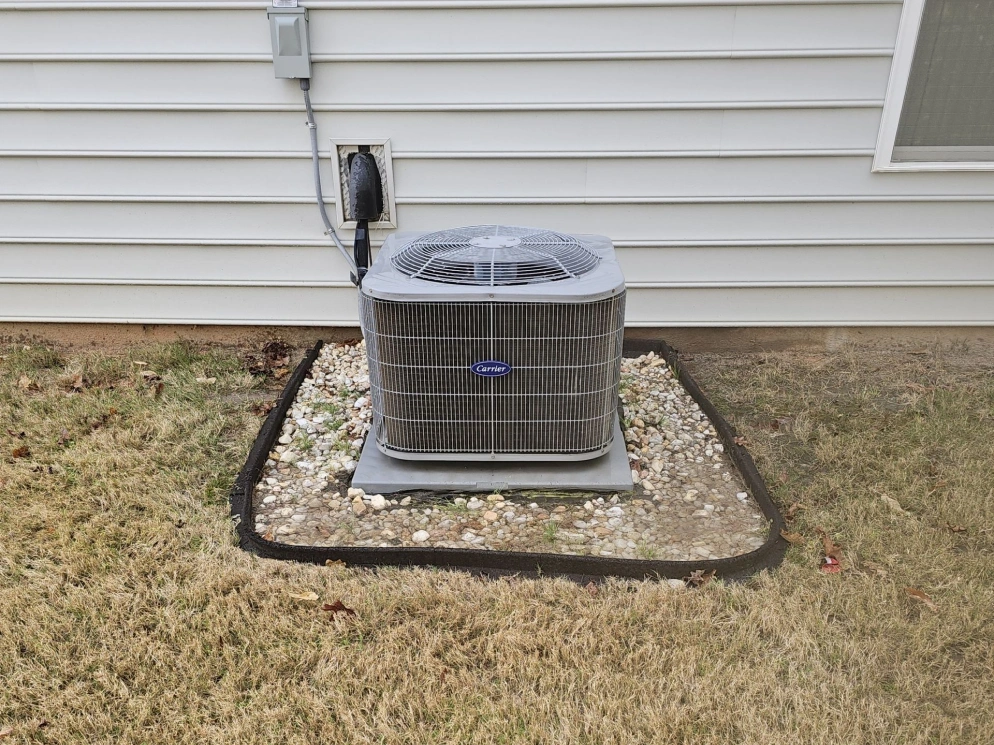
A Carrier condenser after its maintenance visit.
Townhomes, tight envelopes, and corridor specifics
The townhome file
The corridor’s many townhome communities stack their own distinct patterns on the pile: shared walls changing the load math, three-story floor plans whose top levels each run entirely independent climates, courtyard outdoor units where placement and noise matter, and HOA guidelines we navigate without drama because we have read most of them already. Mini-splits solve the third-floor problem weekly, and staging configuration quietly decides the townhome power bills.
Tight modern envelopes run through all of it: better insulation holds humidity indoors, oversized systems short cycle brutally, and the clammy-at-72 complaint is the corridor’s signature symptom. Right-sizing at replacement and dehumidification where readings justify it are the fixes, and both start with measurement rather than catalog.
Commuter service, engineered
Half the corridor commutes into Charlotte daily, so the service model was built to respect it: garage-code installs and maintenance visits that finish before the evening commute returns, precise arrival windows communicated like we actually mean them, and evening-friendly scheduling for the bigger conversations that genuinely need the whole household present. The commuter rhythm is not an accommodation here; it is the operating norm.
The 10% teacher and service-personnel discount runs constantly along the corridor, Indian Land’s schools included, and portfolio landlords with corridor rentals get the batched-maintenance, per-address-records treatment that keeps HVAC the quietest line on the spreadsheet. Every promise on this site crosses the county line intact, fifteen minutes at a time.
A corridor year, in service calls
The warm half
April pollen loads the corridor’s filters on schedule and spring service books out early; summer opens the cooling triage season with the year-eight subdivisions leading the call log, drain clogs running their humid-month campaign, and the tight envelopes generating their clammy-house conversations. The replacement wave works whichever streets hit their birthdays, with the pattern file supplying honest context to every quote.
Storm cells take their summer tax of boards along the corridor like everywhere in the metro, and surge protection at the condenser earns its price in the quotes. The maintained households, heavily weighted toward the active-adult streets, watch the season from the comfortable side as designed.
The cold half
First snaps run the corridor’s furnace-and-heat-pump exam at dawn, and the staging discipline quietly decides which households pay strip-heat prices for heat pump comfort. The 24/7 line works its no-surcharge shift, vulnerable households jumping the queue, and the fall-serviced systems show their preparation in the margins.
Late winter belongs to the planners: shoulder-season replacements booked calmly ahead of the wave, year-two checkups on the newest streets catching builder corners at tune-up prices, and the maintenance rhythm signing another season across the corridor. Then the pollen returns, and the fastest-growing strip in the Carolinas restarts its mechanical year.
New construction and the year-two window
Getting in early on the newest streets
The corridor is still building, and the newest subdivisions offer what the first wave never got: a crew involved early. Builder rough-ins sequenced properly, mini-split heads set before drywall in the bonus rooms that will need them, duct designs reviewed while changes cost markers instead of sheet metal, and commissioning done by instrument rather than by schedule pressure.
For buyers already closed, the year-two window is the equalizer: one thorough inspection catches the value-engineered corners, unconfigured staging, minimal filtration, ducts at inspection minimum, while fixes cost tune-up money. The corridor’s first wave learned this lesson at year-eight prices; the newest streets get to learn it at year-two prices instead.
The upgrades the corridor actually buys
The pattern file extends to upgrades: media filter cabinets that survive real households, smart thermostats configured so heat pump staging stops burning quiet money, dehumidification for the tight envelopes, and bonus-room mini-splits that end the hottest-room-in-the-house argument permanently. Each earns its place by measurement, and each gets priced in writing against the honest alternative of doing nothing.
What the corridor does not get sold: miracle gadgets, panic replacements, or maintenance plans with membership-card theater. The upgrade list is short because the honest one always is, and the free pricing visit sorts which items your specific house justifies before any of them reach an invoice.
The corridor promise
Home-county response fifteen minutes across the line, the pattern file working for you at every diagnosis, stocked trucks that finish repairs first-visit, written prices with honest neighborhood context, and the 24/7 line covering the whole panhandle without a surcharge at any hour. Free pricing visits, Optimus Financing behind the replacement wave, and the 10% discount for the people who hold the corridor together.
The corridor’s mechanical destiny was pre-installed a subdivision at a time. Your leverage, at every repair and every replacement, is hiring the crew that memorized it street by street: (803) 573-2473, fifteen minutes out.
Same crew. Same price. Any hour.
No after-dark surcharge and no phone tree. If your system cannot wait until morning, neither do we.
Indian Land questions, answered from the pattern file
How fast can you get to Indian Land?
Fifteen minutes on an ordinary day, which puts the corridor inside our home-county response band: same-day repairs as the standard, genuine emergencies frequently inside the hour, and arrival windows that respect 521 traffic honestly. The panhandle is core territory on our route sheets, not an outer ring.
My builder warranty just ended. What now?
Book the inspection that maps your position: one thorough tune-up reads where your system sits on the corridor’s curve, prices the likely next failures honestly, and leaves a replacement quote in your drawer if the math is approaching. The warranty cliff is exactly when informed beats improvised, and the visit costs tune-up money.
Why does my three-story townhome’s top floor never cool?
Physics plus value engineering: heat stacks, top-floor duct runs arrive exhausted, and the floor plan was drawn for the inspection rather than the August afternoon. The honest fixes run from balancing and staging configuration to a dedicated mini-split head for the top level, priced side by side, and the third-floor problem is one we retire weekly along the corridor.
Is everyone’s system on my street really identical?
Functionally, in most corridor subdivisions, yes: same builder, same season, same equipment package, same aging curve. That is why the condenser trucks arrive in waves and why our quotes come with neighborhood context. Your unit’s position in the queue is knowable, and knowing beats guessing by exactly the price of a tune-up.
Do you work with the Del Webb and Sun City communities?
Extensively: the active-adult streets anchor our corridor maintenance calendar, value reliability the way we value delivering it, and get scheduling that respects how those households actually run their days. The twice-yearly rhythm is the standing recommendation, and those neighborhoods’ word-of-mouth built half our panhandle presence.
Our house feels cold and clammy at the same time. Broken?
Probably oversized, which is the tight-envelope corridor’s signature ailment: the system wins the temperature fight too fast to dehumidify. Dedicated dehumidification decouples the jobs now, and right-sizing at replacement fixes the cause permanently. The readings settle it at the free visit, and the fix transforms how the house feels at the same thermostat number.
Do you install in the corridor’s new construction directly?
Yes, from rough-in to commissioning: mini-split heads set before drywall, duct designs reviewed while changes are cheap, and systems commissioned by instrument rather than schedule pressure. Builders who have run the sequence with us keep our number, and the buyers of those houses inherit systems that skip the value-engineered corners entirely.
What do you fix most along the corridor?
The pattern’s greatest hits: year-eight capacitors and boards, humid-season drain clogs, staging corrections on heat pumps quietly burning strip heat, third-floor comfort in the townhomes, and the replacement wave working the streets in birthday order. The trucks stock for exactly this list, which is why first-visit fixes are the corridor norm.
Around Indian Land
The county page and the panhandle neighbor carry the wider story, and the corridor keeps every service below employed.
Lancaster County · Van Wyck · AC Repair · AC Replacement · Smart Thermostats · Dehumidification
Want proof before the phone call? The gallery is all real jobs, and the financing page covers the big-ticket math.